
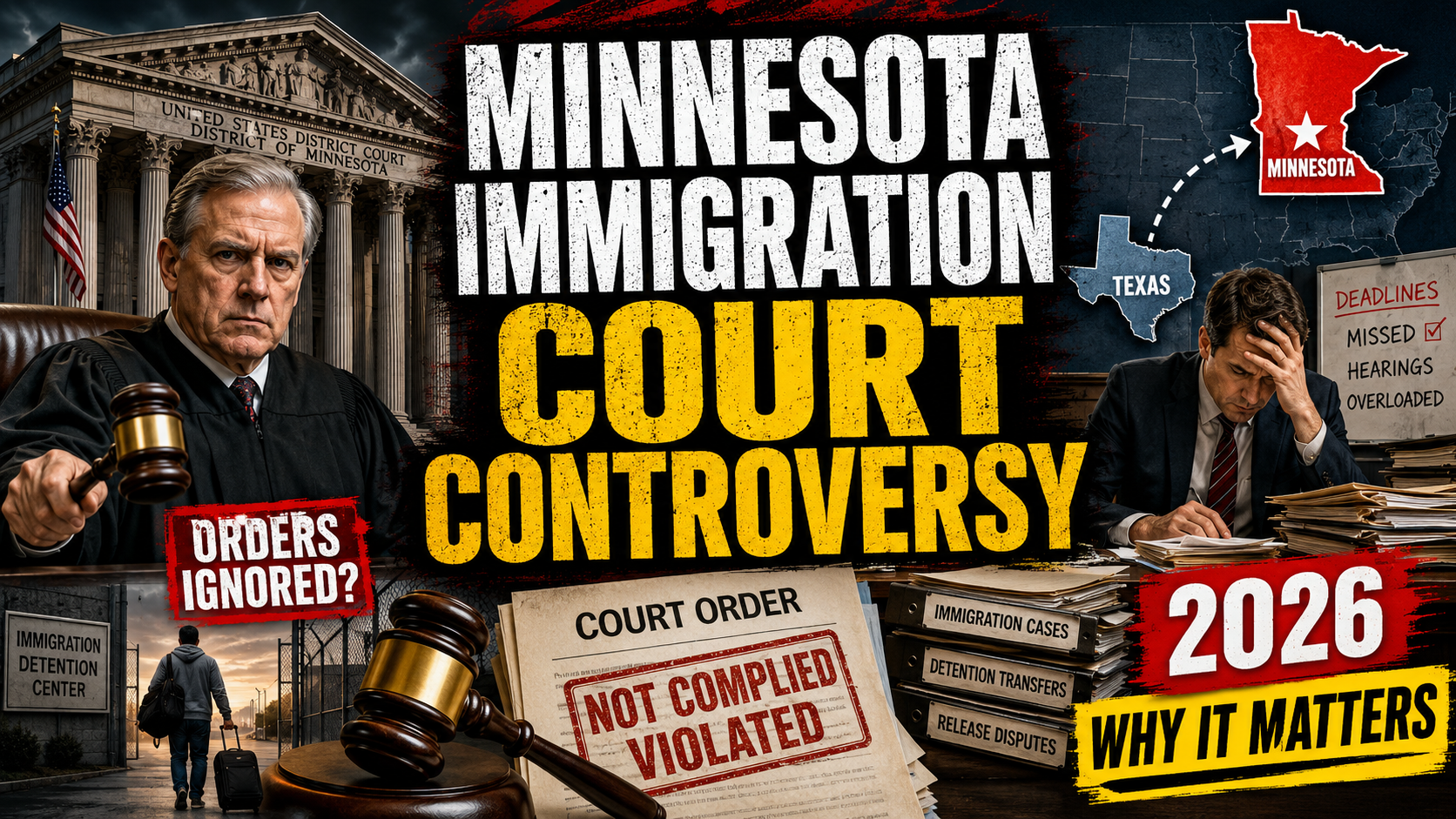
Minnesota Immigration Court Controversy 2026: What Happened and Why It Matters
The Minnesota immigration court controversy of 2026 was not one lawsuit or one controversial ruling. It was a series of federal court disputes that arose after a sharp increase in immigration detention cases overwhelmed Minnesota’s federal courts.
Federal judges repeatedly criticized the government for failing to comply with court orders involving detained immigrants. Those failures included delayed releases, transfers to other states despite court directives, missed filing deadlines, and incomplete compliance with judicial orders. The controversy reached national attention after U.S. District Judge Laura M. Provinzino held a Justice Department attorney in civil contempt, an unusual step in federal litigation.
Quick Answer
The 2026 Minnesota immigration court controversy developed after a surge in immigration enforcement produced hundreds of federal habeas corpus petitions in Minnesota.
Judges reported recurring problems such as:
- Court orders not being carried out on time.
- Immigration detainees being transferred or released contrary to judicial instructions.
- Government attorneys missing filing deadlines.
- Heavy caseloads affecting communication between agencies and the courts.
Several federal judges warned that staffing shortages could not justify repeated failures to comply with court orders.
Why Did the Controversy Begin?
The controversy followed a dramatic increase in immigration enforcement in Minnesota during late 2025 and early 2026.
As more people were detained, the number of habeas corpus petitions filed in federal court rose sharply. A habeas petition allows a detained person to ask a federal judge to determine whether continued detention is lawful.
Minnesota’s federal judges suddenly found themselves managing hundreds of emergency detention challenges at the same time, while government attorneys were assigned unusually large caseloads.
What Problems Did the Courts Identify?
Although each case involved different facts, judges described several recurring issues.
Failure to Follow Court Orders
Multiple judges stated that federal agencies did not always carry out release orders exactly as written.
Reported problems included:
- Delayed releases.
- Transfers to detention facilities outside Minnesota.
- Property not being returned after release.
- Missed reporting deadlines.
Judges stressed that a court order remains legally binding unless it is modified or overturned on appeal.
Administrative Breakdowns
Court hearings revealed communication problems between:
- The Department of Justice.
- Immigration and Customs Enforcement (ICE).
- Local government attorneys.
- Federal courts.
In several hearings, judges questioned whether attorneys responsible for a case had sufficient information about detainees’ locations or the status of court orders.
Growing Caseloads
Government attorneys acknowledged that they were handling far more immigration cases than usual.
Some lawyers told judges they had been assigned well over one hundred active habeas matters within a short period.
Federal judges accepted that the workload was unusually high but repeatedly stated that staffing shortages did not eliminate the obligation to comply with judicial orders.
The Laura Provinzino Contempt Case
The most widely reported dispute involved Rigoberto Soto Jimenez.
Judge Laura Provinzino ordered that:
- He be released in Minnesota.
- His identification documents be returned.
- The government file a report confirming compliance.
Instead, he was released in Texas without several identification documents, and the required court report was not filed on time.
Judge Provinzino later held Special Assistant U.S. Attorney Matthew Isihara in civil contempt after concluding that he had not taken adequate steps to ensure the court’s order was followed.
The court announced a conditional $500-per-day fine, but the government returned the missing documents before any fines became payable.
Other Judges Also Expressed Concern
Judge Provinzino was not the only federal judge to criticize government compliance.
Chief U.S. District Judge Patrick Schiltz publicly stated that ICE had repeatedly failed to comply with court orders in immigration cases and warned that the rule of law required government agencies to follow judicial decisions unless those decisions were stayed or reversed.
Judge Jerry Blackwell also criticized repeated compliance failures and emphasized that constitutional protections apply even during periods of increased immigration enforcement.
Why Were Judges So Concerned?
The controversy extended beyond individual cases.
Federal judges expressed concern that repeated failures could weaken confidence in the judicial process.
Their concerns included:
- Whether executive agencies were responding quickly enough to court orders.
- Whether attorneys were informing courts about compliance problems.
- Whether detained individuals were being deprived of rights because of administrative failures.
- Whether overloaded government offices were creating systemic problems.
The judges emphasized that administrative difficulties do not suspend the authority of federal court orders.
Was the Problem About Immigration Policy?
Not entirely.
The controversy did involve immigration enforcement, but many judicial criticisms focused on procedural compliance, not immigration policy itself.
The courts generally addressed questions such as:
- Was the detention lawful?
- Did the government obey the court’s order?
- Was the required property returned?
- Were deadlines met?
- Did attorneys keep the court informed?
Those procedural issues were separate from broader political debates over immigration policy.
Why Did Habeas Corpus Become Important?
Many of the disputes reached federal court through habeas corpus petitions.
A habeas petition allows a judge to review whether someone is being lawfully detained.
It does not automatically:
- Grant asylum.
- Approve permanent residence.
- Stop future immigration proceedings.
- Cancel a removal case.
Instead, it focuses on whether the person’s current detention complies with federal law and constitutional requirements.
Timeline of the 2026 Minnesota Immigration Court Controversy
| Period | Major Development |
|---|---|
| Late 2025 | Immigration enforcement expanded in Minnesota. |
| January 2026 | Federal habeas filings increased dramatically. |
| February 2026 | Judges reported repeated failures to comply with release orders. |
| February 18, 2026 | Judge Laura Provinzino held DOJ attorney Matthew Isihara in civil contempt. |
| February 20, 2026 | The contempt sanction was lifted after the government returned missing documents. |
| Following months | The Justice Department appealed the contempt ruling while broader litigation continued. |
Why the Controversy Drew National Attention
Several factors made these cases unusual.
First, federal judges rarely impose contempt sanctions on government attorneys personally.
Second, multiple judges independently reported similar compliance problems.
Third, the volume of immigration detention litigation was unusually high for one federal district.
Finally, the controversy highlighted the practical challenges courts face when immigration enforcement expands more quickly than existing legal and administrative systems can handle.
Frequently Asked Questions
What was the Minnesota immigration court controversy?
It referred to a series of federal court disputes during 2026 involving immigration detention, compliance with judicial orders, and the rapid increase in habeas corpus cases in Minnesota.
Was it one court case?
No. The controversy involved multiple federal cases. The most widely reported was Judge Laura Provinzino’s civil contempt ruling against DOJ attorney Matthew Isihara.
Why did judges criticize the government?
Judges cited repeated failures to comply with release orders, missed deadlines, transfers that conflicted with court directives, and poor communication with the courts.
Did the controversy change immigration law?
No. The cases focused primarily on compliance with existing court orders rather than creating new immigration laws.
Why were so many habeas petitions filed?
The increase followed expanded immigration detention practices, which led more detainees to challenge the legality of their custody in federal court.
Final Thoughts
The Minnesota immigration court controversy of 2026 was ultimately a dispute about the administration of justice rather than a single political disagreement over immigration.
Federal judges acknowledged that government lawyers and agencies were operating under extraordinary pressure. At the same time, they consistently emphasized that staffing shortages, communication failures, and administrative burdens do not excuse noncompliance with court orders.
The proceedings underscored a fundamental principle of the U.S. legal system: once a federal court issues a lawful order, every party—including the government—is expected to follow it unless a higher court changes that decision. The controversy became a prominent example of the tension that can arise when rapidly expanding enforcement efforts collide with the judiciary’s responsibility to safeguard due process and enforce its orders.
Disclaimer
This article is intended for informational and educational purposes only. It summarizes publicly available court decisions and reliable news reporting. It does not constitute legal advice or express a view on any pending litigation. Court proceedings may continue through appeals or later rulings, and readers should consult official court records for the most current information.