
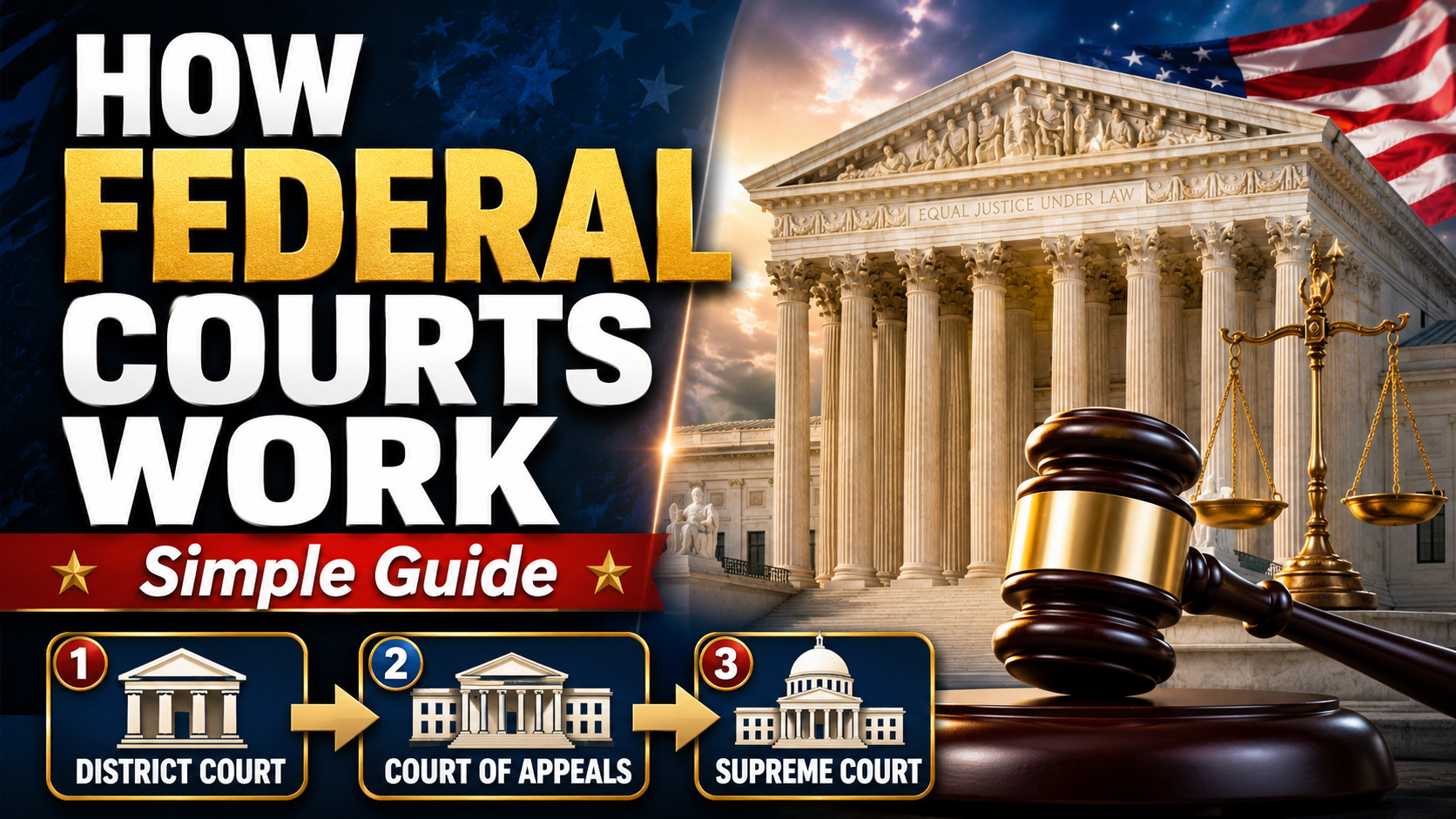
How Federal Courts Work: A Simple Guide to the U.S. Federal Court System
Federal courts are an important part of the United States justice system. They handle cases involving federal laws, constitutional questions, disputes between states, and other matters that require federal authority.
Many people hear about federal court rulings in the news but do not understand how the system works, who has power, how cases move through the courts, or what happens after a judge makes a decision.
This guide explains how federal courts work, the different levels of federal courts, how a case begins, how judges make decisions, and what happens after a ruling.
What Are Federal Courts?
Federal courts are courts established under the authority of the U.S. Constitution and federal laws. They handle legal disputes that involve federal issues rather than only state laws.
The federal court system has authority over specific types of cases, including:
- Cases involving the U.S. Constitution
- Federal laws passed by Congress
- Disputes between states
- Lawsuits involving the federal government
- Bankruptcy cases
- Certain cases involving foreign governments
- Disputes between citizens of different states when certain requirements are met
Federal courts do not replace state courts. Both systems operate separately and handle different types of legal matters.
How Does the Federal Court System Work?
The U.S. federal court system has three main levels:
- Federal District Courts
- Federal Courts of Appeals
- The Supreme Court of the United States
A case usually begins at the district court level. If a party disagrees with the decision, they may appeal to a higher court.
The basic path looks like this:
District Court → Court of Appeals → Supreme Court
However, not every case reaches the Supreme Court. Most federal cases end at the district court or appeals court level.
Level 1: Federal District Courts
Federal district courts are the trial courts of the federal system.
They are where federal cases usually begin. Judges at this level review evidence, hear testimony, examine legal arguments, and make decisions.
There are 94 federal judicial districts across the United States and its territories.
What Happens in a District Court?
A typical federal case may include:
- Filing a complaint or legal petition
- Response from the opposing party
- Exchange of evidence through discovery
- Hearings before the judge
- Trial or legal arguments
- Final ruling
A district court judge may:
- Decide legal questions
- Issue orders
- Approve settlements
- Conduct trials
- Determine whether a party violated federal law
Level 2: Federal Courts of Appeals
Federal courts of appeals review decisions made by district courts.
They do not usually conduct new trials. Instead, they examine whether the lower court made legal errors.
There are 13 federal appellate courts:
- 12 regional courts of appeals
- The Court of Appeals for the Federal Circuit
What Does an Appeals Court Review?
Appeals courts examine issues such as:
- Did the judge correctly apply the law?
- Were proper legal procedures followed?
- Was there a serious mistake that affected the outcome?
The appeals court may:
- Confirm the lower court decision
- Reverse the decision
- Send the case back for further action
Sending a case back is called a remand.
Level 3: The Supreme Court of the United States
The Supreme Court is the highest court in the federal system.
It reviews a small number of cases each year, usually involving major constitutional questions or disagreements between lower courts.
The Supreme Court has nine justices, including the Chief Justice.
Most parties must request permission for the Supreme Court to hear their case by filing a petition for a writ of certiorari.
The Court chooses only a limited number of cases.
A Supreme Court decision becomes the final ruling unless constitutional changes or future court decisions modify the legal interpretation.
How Does a Federal Court Case Begin?
A federal case can begin in several ways depending on the issue.
Common examples include:
Civil Cases
A person, company, or organization files a lawsuit against another party.
Examples:
- Civil rights claims
- Business disputes
- Employment lawsuits
- Immigration-related challenges
Criminal Cases
The federal government charges someone with violating federal criminal law.
Examples:
- Federal fraud charges
- Drug trafficking cases
- Cybercrime cases
Habeas Corpus Cases
A person in government custody may ask a federal court to review whether their detention violates federal law or constitutional rights.
This type of case is common in immigration and prison-related legal disputes.
Who Makes Decisions in Federal Courts?
Federal judges make decisions based on:
- The U.S. Constitution
- Federal statutes
- Previous court decisions
- Legal arguments presented by both sides
- Evidence and facts of the case
Judges do not create laws like Congress does. Their role is to interpret and apply existing laws.
What Is a Federal Court Ruling?
A federal court ruling is an official decision issued by a federal judge or federal appellate court.
A ruling may:
- Resolve a dispute
- Interpret federal law
- Protect constitutional rights
- Require a government agency or person to take action
- Stop certain actions through court orders
The impact of a ruling depends on the court that issued it.
For example:
| Court | Effect of Decision |
|---|---|
| District Court | Usually affects the parties involved in that case |
| Court of Appeals | Applies to federal courts within that circuit |
| Supreme Court | Applies nationwide |
How Do Federal Judges Enforce Their Decisions?
Federal courts have authority to enforce their orders.
If a person, organization, or government agency refuses to follow a court order, the court may take action.
Possible enforcement tools include:
- Contempt of court proceedings
- Fines
- Additional court orders
- Other legal remedies
For example, if a government agency fails to follow a judge’s order, the affected party may ask the court to address the failure.
However, courts must follow legal procedures before imposing penalties.
Federal Courts vs State Courts
Many people confuse federal and state courts.
The main difference is the type of law involved.
| Federal Courts | State Courts |
|---|---|
| Handle federal laws and constitutional issues | Handle state laws |
| Created under federal authority | Created under state authority |
| Federal judges are appointed for life | State judges may have different appointment systems |
| Hear specific categories of cases | Handle most everyday legal disputes |
State courts usually handle matters such as:
- Divorce
- Property disputes
- Most criminal cases
- Traffic violations
- State contract disputes
How Long Do Federal Court Cases Take?
The timeline depends on the complexity of the case.
A simple case may take months.
Complex cases involving:
- Large amounts of evidence
- Multiple parties
- Constitutional questions
- Government agencies
may take years.
Appeals can add significant time because higher courts must review the legal issues.
Common Mistakes People Make About Federal Courts
Mistake 1: Thinking Every Federal Ruling Applies Nationwide
Not every federal court decision creates a nationwide rule.
A district court ruling usually affects only the parties involved unless other courts adopt its reasoning.
Mistake 2: Assuming Judges Can Ignore Laws
Federal judges must follow constitutional rules, federal statutes, and legal precedent.
They cannot simply replace laws with personal opinions.
Mistake 3: Believing Any Case Can Go Directly to the Supreme Court
Most cases cannot go directly to the Supreme Court.
They usually move through lower courts first.
Mistake 4: Confusing Court Orders With New Laws
A judge’s order is not the same as legislation passed by Congress.
A court interprets and applies existing law.
How to Find Federal Court Rulings and Case Information
People can research federal cases through official sources.
Useful resources include:
- PACER (Public Access to Court Electronic Records) for federal case documents
- Federal court websites
- Supreme Court opinions database
- Court of Appeals websites
When reviewing a case, look for:
- Court name
- Case number
- Judge’s name
- Date of ruling
- Legal issue involved
- Whether an appeal was filed
Why Federal Courts Matter
Federal courts play a major role in protecting constitutional rights, resolving disputes, and ensuring government agencies follow the law.
Their decisions can affect:
- Individuals
- Businesses
- Government officials
- Public policies
- Legal rights
Understanding how federal courts work helps people better understand major legal decisions reported in the news.
Frequently Asked Questions
What does a federal court do?
A federal court resolves disputes involving federal laws, constitutional issues, and other matters assigned to federal authority.
Can a federal judge overrule the government?
Yes. Federal courts can block government actions if they violate the Constitution or federal law. However, government agencies can often appeal the decision.
Can federal courts create laws?
No. Federal courts interpret and apply laws. Congress creates federal statutes.
How powerful is a federal judge?
Federal judges have significant authority within their legal jurisdiction. They can issue binding orders, review government actions, and decide legal disputes.
Can someone appeal a federal court ruling?
Yes. A party who believes a legal error occurred may appeal to a federal appeals court.
Conclusion
The federal court system works through a structured process designed to resolve disputes, interpret laws, and protect constitutional principles. Cases usually begin in federal district courts, may move to courts of appeals, and only a small number reach the Supreme Court.
Understanding how federal courts work makes it easier to follow legal news, understand court rulings, and recognize the role courts play in the U.S. government system.
Disclaimer
The information provided in this article is for general informational and educational purposes only. It is not intended to be legal advice and should not be considered a substitute for consulting a qualified attorney or legal professional.
Federal court procedures, laws, and legal interpretations can change over time. While we make reasonable efforts to provide accurate and up-to-date information, we do not guarantee that all information is complete, current, or applicable to every individual situation.
Every legal case is different, and the outcome of any court matter depends on specific facts, applicable laws, and judicial decisions. Readers should seek professional legal advice before making decisions based on information discussed in this article.
This website does not provide attorney-client services, establish an attorney-client relationship, or represent any person in legal matters.