
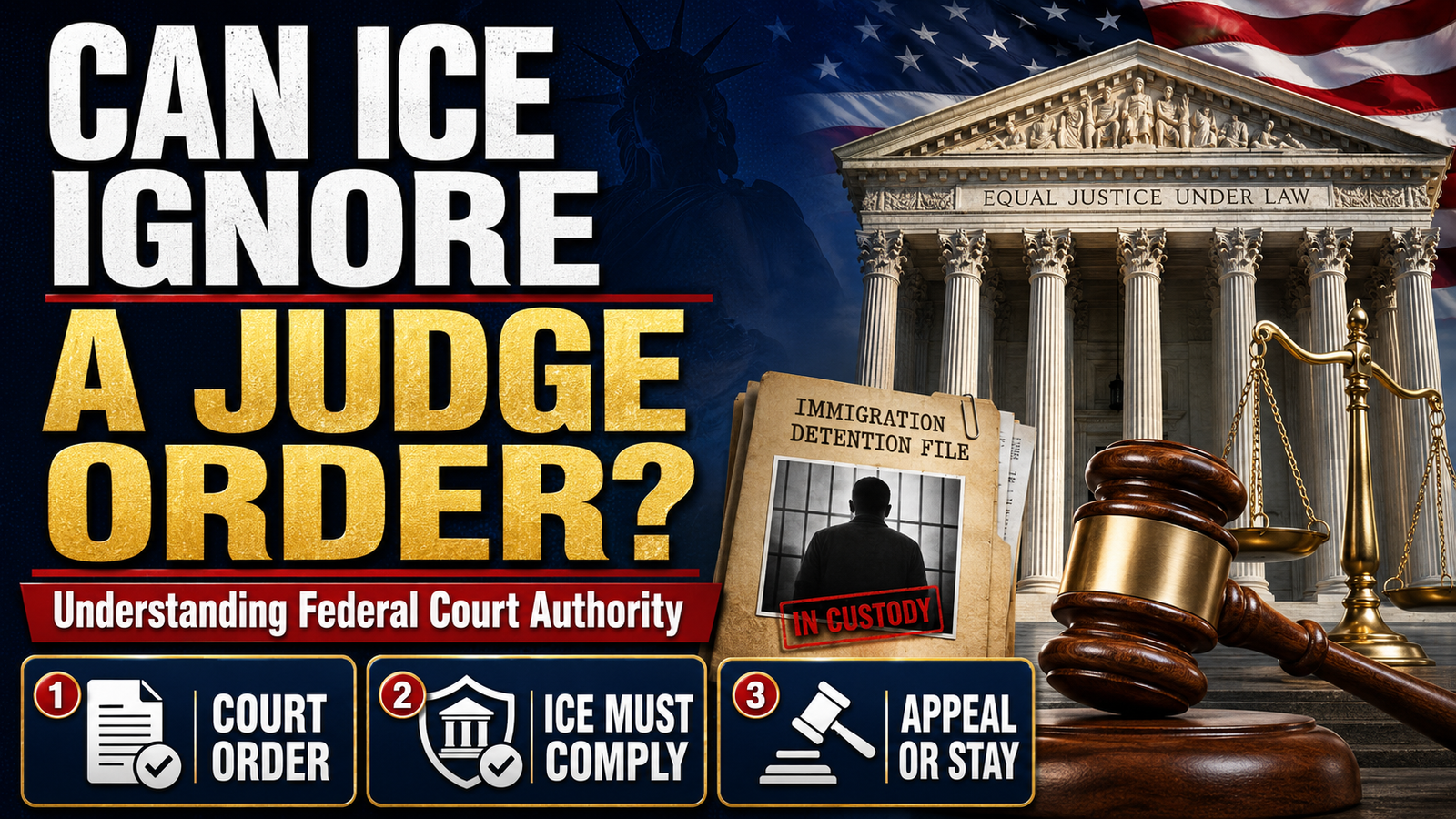
Can ICE Ignore a Judge Order? Understanding Federal Court Authority
A federal court order is a legally binding command that must generally be followed by the parties involved in a case, including government agencies such as U.S. Immigration and Customs Enforcement (ICE).
The short answer is: No, ICE cannot simply ignore a judge’s order. Federal agencies must comply with valid court orders unless the order is changed, stayed, or overturned through the legal process.
When disputes happen between ICE and federal courts, the issue usually involves whether immigration officials followed the court’s instructions, misunderstood the order, or failed to take required action.
What Happens When a Judge Issues an Order Against ICE?
When a federal judge issues an order involving ICE, the agency is legally required to follow that order.
A judge’s order may require ICE to:
- Release a person from custody
- Stop a specific action
- Provide documents or information
- Follow certain legal procedures
- Report compliance to the court
The order remains effective unless:
- A higher court changes it
- The judge modifies it
- An appeal results in a different decision
- A stay temporarily pauses enforcement
Simply disagreeing with the ruling does not allow ICE to ignore it.
Why Must ICE Follow Federal Court Orders?
ICE is part of the Department of Homeland Security (DHS), which is part of the executive branch of the federal government.
Although ICE has authority to enforce immigration laws, that authority must operate within legal limits.
Federal courts have the power to review whether government agencies:
- Follow federal laws
- Respect constitutional rights
- Follow required procedures
- Comply with court decisions
This principle comes from the separation of powers established by the U.S. Constitution.
Can a Government Agency Refuse to Follow a Court Order?
Government agencies, including ICE, are not above federal court authority.
If an agency believes a court order is incorrect, it generally must use legal options such as:
- Filing an appeal
- Requesting clarification
- Asking the court to modify the order
- Seeking a temporary stay
The agency cannot decide on its own that a court order does not apply.
What If ICE Fails to Follow a Judge’s Order?
If ICE or another government agency does not comply with a federal court order, the affected party can ask the court to address the problem.
Possible court responses include:
Contempt Proceedings
A court may consider whether someone violated a lawful order.
A contempt proceeding may examine:
- Whether a valid order existed
- Whether the agency knew about the order
- Whether reasonable steps were taken to comply
- Whether the failure was intentional or caused by other circumstances
Additional Court Orders
A judge may issue further instructions requiring the government to correct the problem.
Examples:
- Providing missing documents
- Completing required actions
- Reporting compliance updates
Sanctions in Certain Situations
Courts may have authority to impose sanctions when legal requirements are met.
The type of sanction depends on:
- The facts of the case
- The nature of the violation
- Applicable law
- Court authority
Can ICE Appeal a Judge’s Order?
Yes. Like other parties in federal court, the government may challenge certain decisions through the appeals process.
The normal process may include:
- District court decision
- Appeal to a federal court of appeals
- Possible review by the Supreme Court
However, filing an appeal does not automatically stop the original order.
The government usually must request a stay if it wants the order paused while an appeal is considered.
Example: ICE and Immigration Release Orders
A common dispute involves a federal judge ordering the government to release an immigration detainee.
The court may require:
- Release from custody
- Return of personal property
- Submission of compliance information
If officials fail to complete those actions, the court may ask why the order was not followed.
The key question is usually not whether the government agreed with the order, but whether it took legally required steps to comply.
Does ICE Have Special Power to Ignore Court Decisions?
No. ICE has enforcement authority, but that authority is limited by federal law and court oversight.
Immigration officials must balance:
- Immigration enforcement responsibilities
- Court orders
- Due process requirements
- Individual legal rights
Federal courts exist partly to ensure that government agencies operate within their legal authority.
Difference Between Disagreeing With an Order and Ignoring It
These situations are different:
| Situation | Legal Meaning |
|---|---|
| ICE disagrees with a judge’s decision | Government may appeal |
| ICE believes an order is unclear | Government may request clarification |
| ICE follows legal appeal procedures | Allowed |
| ICE refuses to comply without legal action | May create enforcement issues |
A disagreement does not remove the obligation to follow a court order.
How Federal Courts Monitor Government Compliance
Judges may require government officials to provide updates showing that an order has been completed.
Courts may review:
- Written reports
- Evidence of compliance
- Explanations from government attorneys
- Additional hearings
This allows judges to determine whether their orders are being respected.
Common Misunderstandings About ICE and Court Orders
Misunderstanding 1: Government Agencies Can Ignore Judges
Government agencies must follow lawful court orders just like private parties.
Misunderstanding 2: A Judge Controls Immigration Policy
Federal judges do not create immigration policies. They decide whether government actions follow existing laws.
Misunderstanding 3: Every Failure Is Automatically Contempt
Not every mistake or delay results in contempt. Courts usually examine the facts, reasons for noncompliance, and whether officials acted reasonably.
How to Find Immigration Court and Federal Court Updates
People interested in immigration-related federal cases can review information through:
- Federal court records through PACER
- Official federal court websites
- Department of Justice announcements
- Court opinions and legal filings
Important details include:
- Case name
- Court
- Judge
- Date of order
- Specific requirements in the ruling
Frequently Asked Questions
Can ICE ignore a federal judge’s order?
No. ICE must follow valid federal court orders unless the order is changed, stayed, or overturned through legal procedures.
What can happen if ICE violates a court order?
A court may review the situation, require corrective action, or consider contempt proceedings if legal requirements are met.
Can the government appeal an ICE-related court ruling?
Yes. The government may appeal certain decisions, but an appeal does not automatically cancel the existing order.
Can a federal judge order ICE to release someone?
In some cases, federal courts may order government officials to take action if they find that legal requirements have been violated.
Who has more power, ICE or a federal judge?
They have different roles. ICE enforces immigration laws, while federal judges interpret laws and can review whether government actions comply with legal requirements.
Conclusion
ICE cannot simply ignore a federal judge’s order. Federal agencies must respect court authority and use legal procedures if they disagree with a ruling.
When conflicts occur, federal courts can review whether government officials followed their obligations and may require corrective action when necessary. The legal system relies on this balance between executive enforcement authority and judicial oversight.
Disclaimer:
The information provided in this article is for general educational and informational purposes only and should not be considered legal advice. Immigration laws, federal court procedures, and government enforcement policies can be complex and may change over time. Each legal situation depends on specific facts and circumstances. While we strive to provide accurate and reliable information, readers should consult a qualified immigration attorney or legal professional for advice regarding their individual case. This website does not provide legal representation or create an attorney-client relationship.