
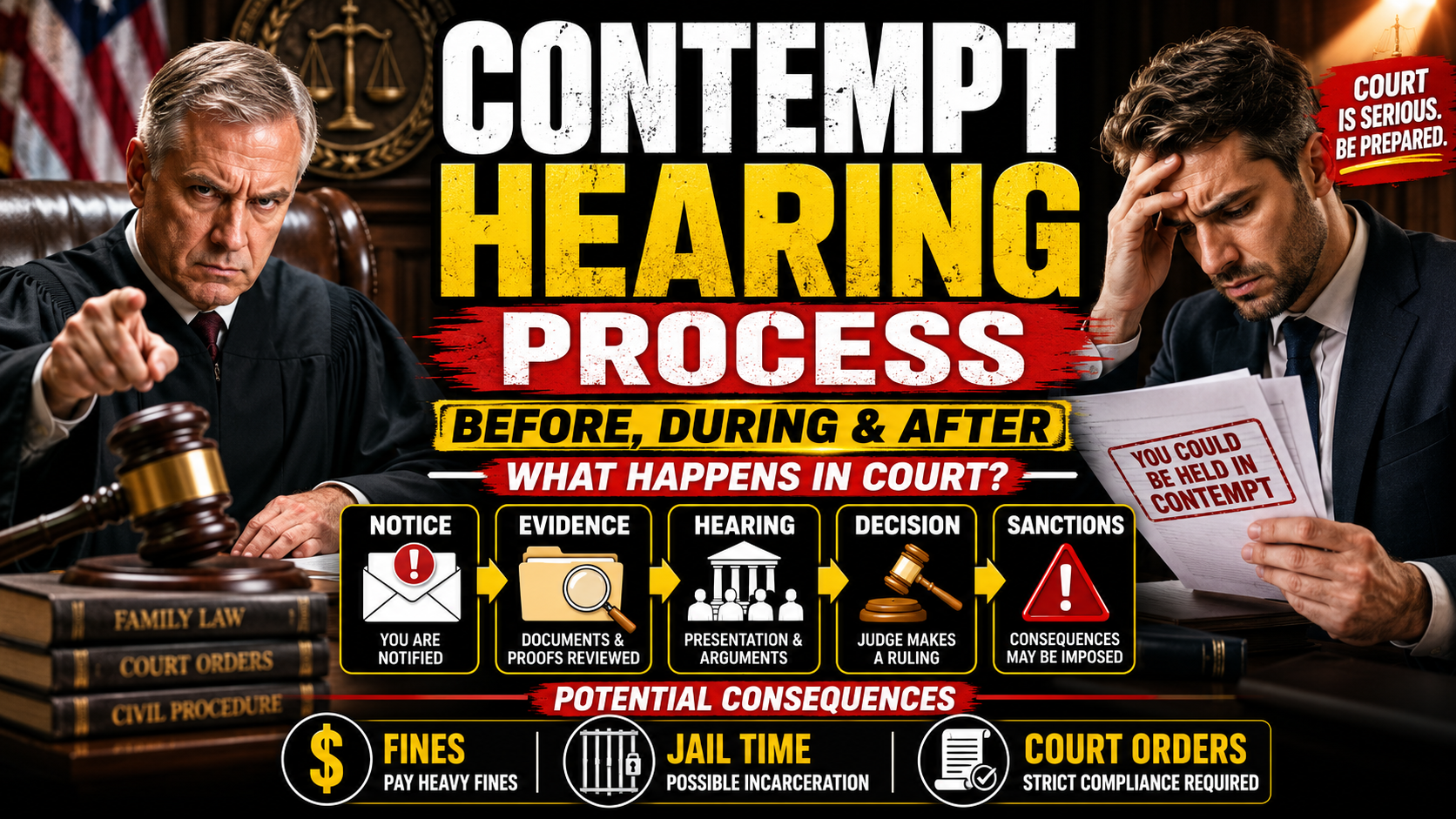
Contempt Hearing Process: What Happens Before, During, and After a Court Hearing
A contempt hearing is a court proceeding where a judge decides whether a person or organization has failed to obey a court order or acted in a way that interferes with the administration of justice.
The hearing gives the accused party an opportunity to explain what happened before the court decides whether contempt has occurred. Not every allegation of contempt results in a finding against the person involved.
Because contempt can lead to fines, other sanctions, or even imprisonment in some situations, courts generally follow established legal procedures before making a decision.
Quick Answer
A contempt hearing is a court hearing where a judge determines whether someone violated a court order or committed conduct that may justify a contempt finding.
Although procedures vary by jurisdiction, the process typically includes:
- A possible violation of a court order.
- Notice that contempt is being considered.
- A hearing before a judge.
- Presentation of evidence and arguments.
- The judge’s decision.
- Any sanctions or enforcement orders, if appropriate.
What Is a Contempt Hearing?
A contempt hearing is not a separate lawsuit.
Instead, it is usually part of an existing court case.
Its purpose is to determine whether:
- A court order was violated.
- The violation was intentional or unreasonable.
- Compliance was possible.
- Contempt sanctions are legally appropriate.
The hearing also protects the rights of the person accused by allowing them to present evidence and explain their actions.
When Does a Court Schedule a Contempt Hearing?
A judge may schedule a contempt hearing after receiving information suggesting that a court order has not been followed.
This may happen when:
- A party files a motion alleging noncompliance.
- The judge observes misconduct in court.
- A government agency reports a violation.
- Another participant informs the court that an order has not been obeyed.
The court does not automatically assume contempt occurred. The hearing is intended to determine the facts.
Step-by-Step Contempt Hearing Process
Although procedures differ between jurisdictions, many contempt proceedings follow a similar pattern.
Step 1: A Court Order Is Issued
The process usually begins after a judge issues a lawful order.
Examples include:
- Child custody orders.
- Child support orders.
- Injunctions.
- Discovery orders.
- Immigration release orders.
- Property return orders.
- Protective orders.
The order should clearly explain what must be done.
Step 2: An Alleged Violation Occurs
Someone claims the order was not followed.
Examples include:
- Missing a court deadline.
- Refusing to return property.
- Ignoring a custody order.
- Violating a restraining order.
- Failing to produce required documents.
At this stage, the court has not yet determined whether contempt actually occurred.
Step 3: Notice Is Given
Before most contempt hearings, the person accused receives notice explaining:
- The alleged violation.
- The date of the hearing.
- The possible consequences.
- The opportunity to respond.
Providing notice is an important part of due process.
Step 4: The Hearing Takes Place
During the hearing, both sides may present information.
Depending on the case, this may include:
- Witness testimony.
- Court documents.
- Emails or written communications.
- Photographs.
- Financial records.
- Other relevant evidence.
The judge may also ask questions to better understand what happened.
Step 5: The Judge Reviews the Evidence
The judge considers several factors, including:
- Was the court order clear?
- Did the person know about the order?
- Was compliance reasonably possible?
- Was the failure intentional?
- Has the person since complied?
The answers help determine whether contempt is appropriate.
Step 6: The Judge Issues a Decision
After reviewing the evidence, the judge may:
- Find no contempt.
- Order additional compliance.
- Continue the hearing.
- Hold the person in civil contempt.
- Hold the person in criminal contempt where permitted by law.
- Impose other lawful sanctions.
The outcome depends on the facts and the governing law.
What Evidence Can Be Used?
Evidence varies by case but often includes:
- Court orders.
- Written correspondence.
- Text messages.
- Emails.
- Bank records.
- Payment records.
- Medical records, when legally relevant.
- Business records.
- Official government documents.
- Testimony from witnesses.
The judge evaluates the reliability and relevance of the evidence before making a decision.
What Happens After a Contempt Hearing?
Several outcomes are possible.
No Contempt Found
If the judge concludes that contempt has not been proven, no contempt sanctions are imposed.
Additional Time to Comply
The judge may allow additional time if the violation resulted from misunderstanding or circumstances beyond the person’s control.
Civil Contempt
Civil contempt usually focuses on encouraging compliance.
Possible remedies include:
- Daily fines.
- Orders requiring compliance.
- Payment of certain costs where permitted.
- Other coercive measures allowed by law.
These sanctions often end once the person complies.
Criminal Contempt
In more serious situations, criminal contempt may result in fixed penalties, such as fines or imprisonment, depending on the applicable law and procedural safeguards.
Can Someone Defend Against Contempt?
Yes.
The accused person generally has an opportunity to explain why contempt should not be imposed.
Possible defenses may include:
- The order was unclear.
- Compliance was impossible.
- The person never received proper notice.
- The violation was not intentional.
- The order had already been satisfied.
- The alleged facts are inaccurate.
Whether a defense succeeds depends on the evidence and the law governing the case.
Real-World Example
A well-known example occurred during a 2026 federal immigration case in Minnesota.
U.S. District Judge Laura M. Provinzino scheduled a contempt hearing after concluding that a federal release order had not been fully carried out. The detainee had been released in Texas instead of Minnesota, important identification documents had not been returned, and the required compliance report had not been filed on time.
At the hearing, government representatives explained the circumstances and answered the court’s questions. After reviewing the evidence, Judge Provinzino found Special Assistant U.S. Attorney Matthew Isihara in civil contempt and imposed a conditional daily fine designed to encourage compliance. Once the missing documents were returned, the coercive sanction was lifted.
The case illustrates how a contempt hearing allows the court to determine the facts before deciding whether sanctions are appropriate.
Civil vs. Criminal Contempt Hearings
| Civil Contempt Hearing | Criminal Contempt Hearing |
|---|---|
| Focuses on compliance | Focuses on punishment |
| Often ends after compliance | Penalty generally remains after conviction |
| Frequently involves court orders | Often involves misconduct affecting the court |
| May include coercive fines | May include fixed fines or imprisonment |
| Common in civil litigation | Used in more serious contempt cases |
The procedures differ depending on the jurisdiction and the type of contempt involved.
Frequently Asked Questions
What is the purpose of a contempt hearing?
A contempt hearing allows a judge to decide whether someone violated a court order or interfered with the administration of justice and whether sanctions are legally justified.
Do you automatically lose a contempt hearing if someone files a motion?
No. Filing a contempt motion only starts the process. The judge must review the evidence before deciding whether contempt occurred.
Can new evidence be presented?
Yes. Witnesses, documents, financial records, and other relevant evidence may be presented, subject to the court’s rules.
What happens if the judge finds contempt?
Depending on the circumstances, the judge may order compliance, impose fines, issue other sanctions, or, in some cases, order imprisonment if permitted by law.
Can a contempt decision be appealed?
In many jurisdictions, certain contempt orders can be reviewed by a higher court. The availability and procedure for an appeal depend on the applicable law.
Final Thoughts
A contempt hearing is designed to ensure fairness while protecting the authority of the courts. Before imposing sanctions, judges generally give the accused person an opportunity to explain what happened and present evidence.
Many contempt cases are resolved through compliance rather than punishment. Courts often prefer that parties correct violations and follow lawful orders instead of imposing severe penalties. Understanding the hearing process can help parties appreciate both their obligations under a court order and their right to be heard before a contempt finding is made.
Disclaimer
This article is for informational and educational purposes only. It explains the general contempt hearing process and is not legal advice. Court procedures and contempt laws vary by jurisdiction. Anyone involved in a contempt proceeding should consult a qualified attorney or review the applicable court rules.