
Judge Provinzino Contempt Ruling: Why the Federal Court Held a DOJ Attorney in Civil Contempt
Judge Laura M. Provinzino’s contempt ruling became one of the most closely watched federal immigration decisions of 2026. The case drew national attention because it is uncommon for a federal judge to hold a Department of Justice attorney personally in civil contempt during active litigation.
The ruling did not concern immigration policy itself. Instead, it focused on whether the federal government complied with a clear court order involving the release of an immigration detainee and the return of his identification documents.
Quick Answer
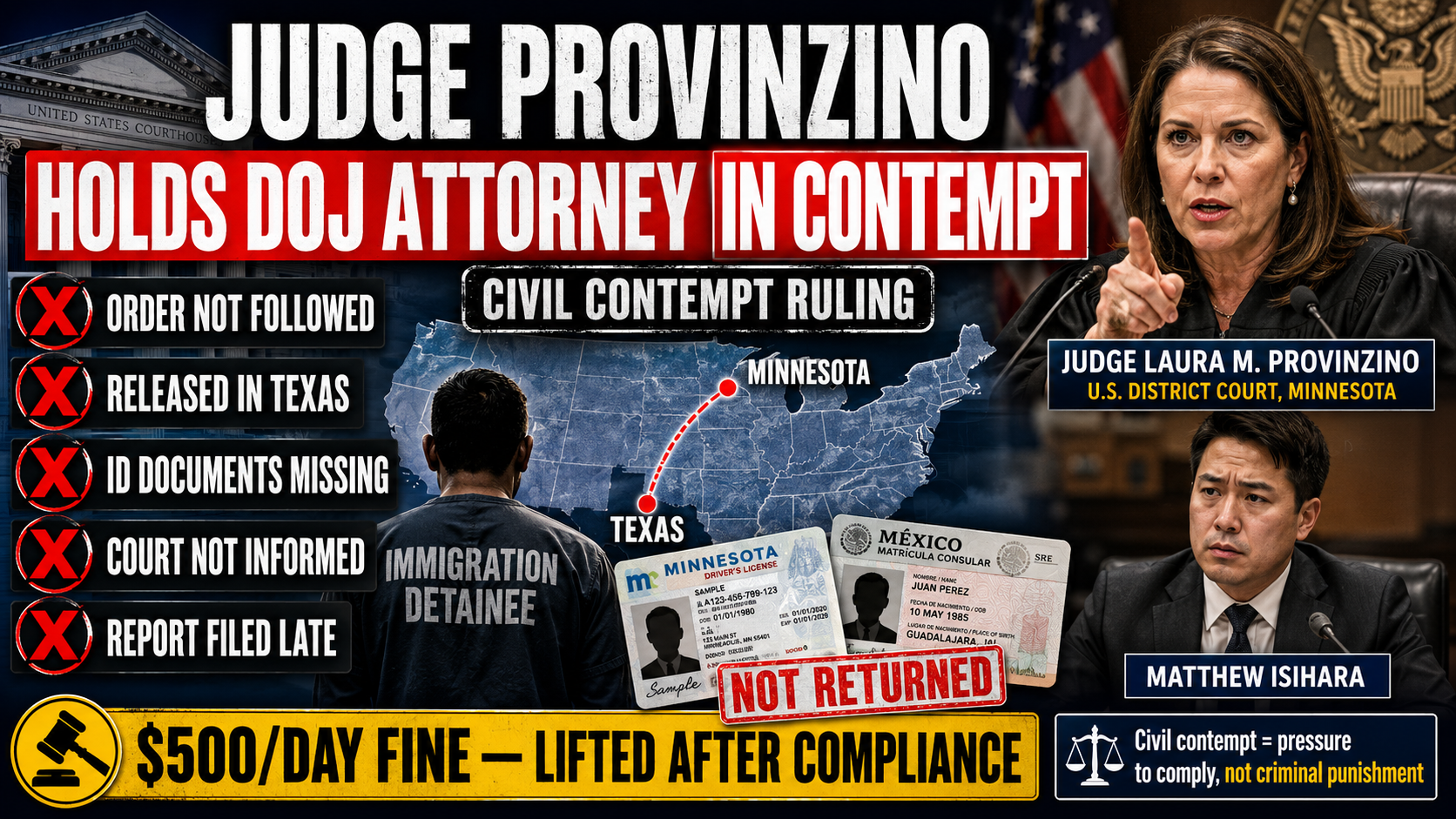
Judge Laura Provinzino held Special Assistant U.S. Attorney Matthew Isihara in civil contempt of court after finding that he failed to take reasonable steps to ensure compliance with a federal court order. The judge concluded that the government did not fully carry out her release order, failed to return important identification documents on time, and did not promptly inform the court about the problems. She imposed a conditional $500-per-day coercive fine, but the sanction was lifted after the government returned the missing documents before any payment became due.
What Led to the Contempt Ruling?
The dispute began with the federal habeas corpus case of Rigoberto Soto Jimenez, an immigration detainee who challenged the legality of his detention.
After reviewing the case, Judge Provinzino ordered the government to:
- Release Soto Jimenez in Minnesota.
- Return all of his personal property, including identification documents.
- File a report confirming that the order had been followed.
Although Soto Jimenez was released, the court found that he was released in Texas instead of Minnesota and without several important identification documents. The required compliance report was also not filed on time.
Why Did Judge Provinzino Hold Matthew Isihara in Contempt?
The court determined that Isihara, the DOJ attorney assigned to the case, had received the court’s order but failed to ensure it reached the appropriate ICE officials through the normal communication process.
According to the ruling, he also failed to:
- Monitor whether the release order was carried out correctly.
- Respond promptly after learning the order had not been fully followed.
- Notify the court about the compliance problems.
- Request additional time if compliance could not be achieved.
Judge Provinzino acknowledged that the U.S. Attorney’s Office was under significant workload pressure but concluded that heavy caseloads did not excuse noncompliance with a federal court order.
Why Was the Missing Identification So Important?
The missing property included government-issued identification documents that are essential for everyday activities.
Without identification, a person may have difficulty:
- Traveling by air.
- Verifying identity.
- Accessing financial services.
- Obtaining employment.
- Completing housing paperwork.
The judge viewed the missing documents as a serious practical problem rather than a minor administrative mistake.
Was This a Criminal Contempt Case?
No.
Judge Provinzino’s ruling involved civil contempt, not criminal contempt.
The difference is important.
| Civil Contempt | Criminal Contempt |
|---|---|
| Encourages compliance with a court order | Punishes completed misconduct |
| Usually conditional | Usually results in a fixed punishment |
| Ends when compliance occurs | Continues even after compliance |
| Often includes coercive fines | May include fines or imprisonment |
The purpose of the ruling was to encourage immediate compliance, not to punish the attorney with a criminal conviction.
What Penalty Did the Judge Order?
Judge Provinzino ordered that Isihara would face a $500 daily fine beginning if the missing identification documents were not returned by the deadline.
However, the government returned the documents before the fine started to accumulate.
Because compliance was achieved, the court ruled that the contempt had been purged, meaning the coercive sanction no longer served its purpose and no money was collected.
Why Did the Case Receive National Attention?
Several factors made the ruling unusual.
First, federal judges rarely hold DOJ attorneys personally in civil contempt.
Second, the case occurred during a period when Minnesota federal courts were handling an unusually large number of immigration habeas petitions.
Third, the ruling highlighted broader concerns about communication between DOJ attorneys, ICE officials, and the federal courts.
Legal commentators noted that the decision underscored the judiciary’s expectation that government lawyers promptly communicate court orders and report compliance problems rather than allowing them to go unaddressed.
Did the DOJ Accept the Ruling?
No.
The Department of Justice appealed the contempt finding.
The government’s position was that an individual attorney should not be personally sanctioned for operational decisions carried out by another federal agency, particularly when the attorney did not directly control detention facilities or property management.
The Eighth Circuit allowed the appeal to proceed, meaning the legal issues surrounding the contempt ruling continue to receive judicial review.
Why the Ruling Matters
Judge Provinzino’s decision reinforces several principles that apply in federal litigation:
- Court orders must be followed unless they are stayed or overturned.
- Government attorneys have a duty to communicate court directives to the appropriate agencies.
- Lawyers should promptly inform the court if compliance problems arise.
- Administrative workload alone does not excuse failure to obey judicial orders.
Although the contempt sanction was later lifted after compliance, the ruling has become an important example of how federal courts may respond when government agencies fail to carry out judicial directives.
Frequently Asked Questions
Who did Judge Provinzino hold in contempt?
Judge Laura Provinzino held Special Assistant U.S. Attorney Matthew Isihara in civil contempt for failing to ensure compliance with a federal court order.
Why was the attorney held in contempt?
The court found that the government failed to fully comply with a release order, did not return identification documents on time, and failed to promptly report these issues to the court.
Was the attorney criminally charged?
No. The ruling involved civil contempt only. It was not a criminal prosecution.
Did the attorney pay the $500 daily fine?
No. The government returned the missing documents before the daily fine began, so no payment became due.
Is the ruling final?
The DOJ appealed the contempt finding. While the coercive sanction ended after compliance, the appeal continues to address the legal issues raised by the ruling.
Final Thoughts
Judge Laura Provinzino’s contempt ruling was not simply about one missed deadline or one administrative mistake. It addressed the broader responsibility of government attorneys to ensure that federal court orders are communicated, monitored, and followed.
Although the court lifted the coercive sanction after the government returned the missing documents, the ruling remains a significant example of judicial oversight in immigration litigation. It demonstrates that federal courts expect all parties—including the government—to comply with lawful orders and to notify the court immediately when compliance becomes difficult or impossible.
Disclaimer
This article is provided for informational and educational purposes only. It summarizes publicly available court records and reputable reporting. It is not legal advice. Because the underlying contempt ruling has been appealed, readers should consult official court records for the latest developments.