
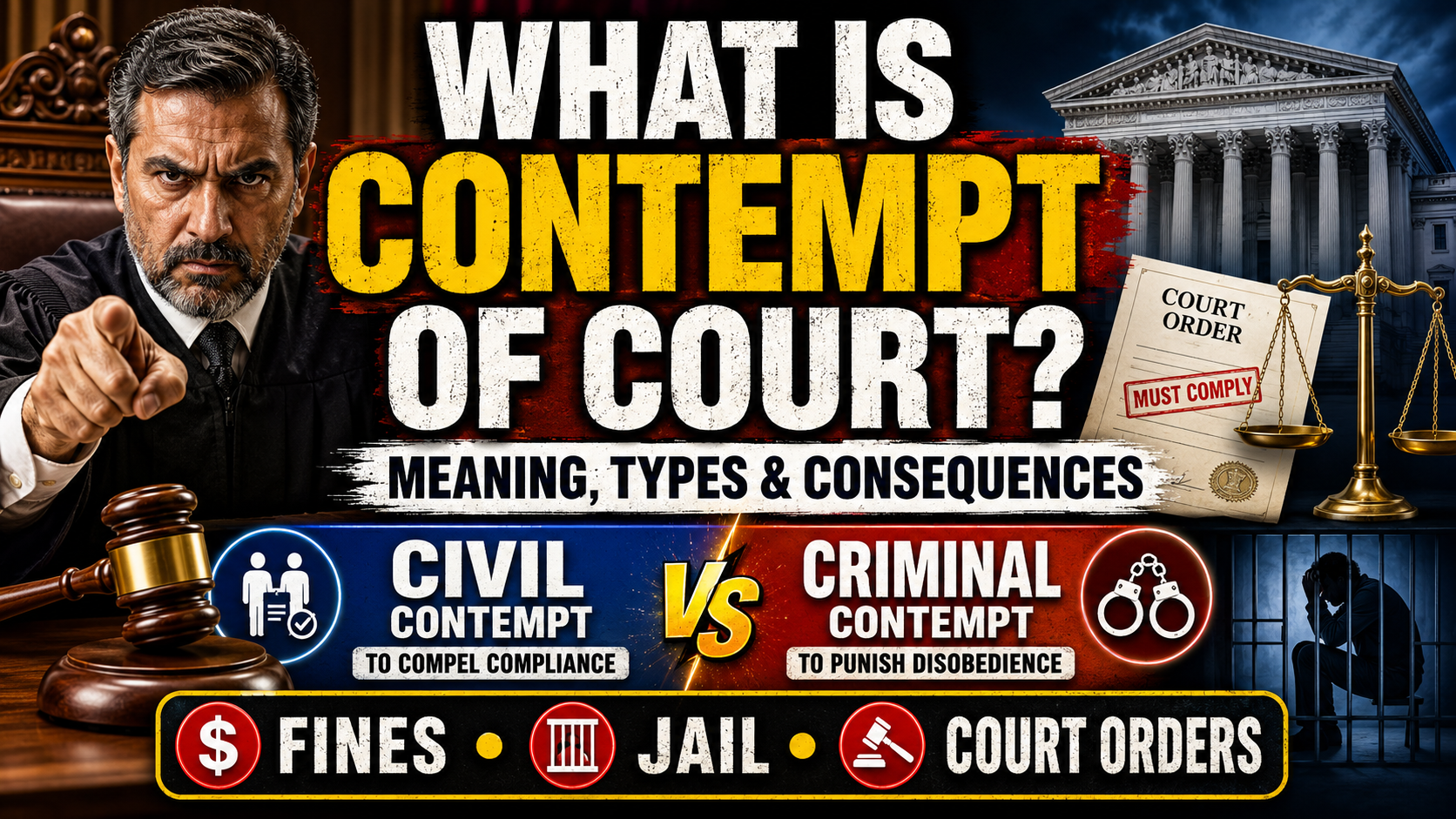
What Is Contempt of Court? Meaning, Types, Examples, and Legal Consequences
Contempt of court is a legal finding that a person or organization has failed to respect the authority of a court or has disobeyed a court order. Courts use contempt powers to protect the judicial process and to ensure that their lawful decisions are followed.
Contempt does not always involve dramatic behavior in a courtroom. It can also occur when someone ignores a judge’s written order, refuses to provide required information, or interferes with the administration of justice.
Quick Answer
Contempt of court occurs when a person intentionally disobeys a court order, disrupts court proceedings, or otherwise interferes with the court’s ability to administer justice.
Depending on the circumstances, a judge may impose:
- Fines
- Imprisonment
- Orders requiring compliance
- Other legal sanctions permitted by law
The exact rules vary by country and legal system.
What Does Contempt of Court Mean?
Contempt of court is a legal mechanism that allows judges to enforce their authority and protect the fairness of judicial proceedings.
Courts issue orders that parties are expected to follow. If someone refuses to comply without a valid legal reason, the court may determine that the conduct amounts to contempt.
The purpose is not simply to punish people. In many situations, the goal is to encourage compliance with the court’s order or to prevent actions that interfere with justice.
Why Do Courts Have Contempt Powers?
Courts rely on their orders being respected.
Without enforcement powers:
- Court judgments could be ignored.
- Witnesses might refuse to testify.
- Parties could violate injunctions without consequences.
- Trials could become disorderly.
- Victims and litigants might never receive the remedies ordered by the court.
Contempt powers help courts ensure that legal decisions are meaningful rather than merely advisory.
Types of Contempt of Court
Most legal systems recognize two primary forms of contempt.
Civil Contempt
Civil contempt is designed to encourage someone to comply with a court order.
Common examples include:
- Refusing to obey an injunction.
- Failing to return property ordered by a court.
- Ignoring a child support order.
- Refusing to produce documents required during litigation.
- Failing to follow a custody order.
Civil contempt often ends once the person complies with the court’s directive.
Criminal Contempt
Criminal contempt punishes conduct that undermines the authority or dignity of the court.
Examples may include:
- Disrupting courtroom proceedings.
- Threatening a judge or witness.
- Intentionally violating a court order after being warned.
- Refusing to testify when legally required.
- Repeatedly interrupting court proceedings.
Criminal contempt can result in fixed penalties such as fines or imprisonment.
Civil vs. Criminal Contempt
| Civil Contempt | Criminal Contempt |
|---|---|
| Encourages compliance | Punishes misconduct |
| Usually conditional | Usually fixed punishment |
| May end after compliance | Punishment remains after conviction |
| Protects private rights | Protects the authority of the court |
| Common in family, civil, and regulatory cases | Common in disruptive or deliberate misconduct cases |
The legal procedures and standards may differ depending on the country and the applicable laws.
Direct and Indirect Contempt
Another way courts classify contempt is by where it occurs.
Direct Contempt
Direct contempt happens in the presence of the judge.
Examples include:
- Interrupting a hearing.
- Refusing to stop speaking after repeated warnings.
- Using abusive language toward the court.
- Creating serious disruptions during a trial.
Because the judge personally witnesses the conduct, direct contempt may sometimes be handled immediately.
Indirect Contempt
Indirect contempt occurs outside the courtroom.
Examples include:
- Ignoring a written court order.
- Missing a court-ordered deadline.
- Refusing to pay court-ordered support.
- Violating a restraining order.
- Failing to comply with an injunction.
Indirect contempt usually requires additional court proceedings before sanctions are imposed.
Common Examples of Contempt of Court
Contempt can arise in many different legal situations.
Examples include:
- Refusing to obey a custody order.
- Violating a restraining order.
- Ignoring a court-ordered payment.
- Refusing to provide evidence ordered by the court.
- Failing to return property as directed.
- Deliberately interfering with a witness.
- Disobeying an injunction issued by a judge.
Not every mistake results in contempt. Courts often consider whether the person knowingly failed to comply and whether compliance was reasonably possible.
What Happens If Someone Is Found in Contempt?
The consequences depend on:
- The type of contempt.
- The seriousness of the conduct.
- The applicable law.
- Whether the person later complies with the order.
Possible consequences include:
- Monetary fines.
- Jail or imprisonment.
- Daily financial penalties until compliance.
- Payment of legal costs in some jurisdictions.
- Additional court orders requiring corrective action.
The specific penalties vary by country and by the facts of each case.
Can Someone Avoid Being Held in Contempt?
Sometimes, yes.
A court may decide not to impose contempt sanctions if a person can show that:
- Compliance was genuinely impossible.
- The order was unclear.
- The failure was not intentional.
- The person made reasonable efforts to comply.
- Compliance occurred before sanctions became necessary.
Simply disagreeing with a court order is generally not enough. The usual legal remedy is to seek reconsideration or appeal rather than ignore the order.
A Real-World Example
A useful example comes from a 2026 federal immigration case in Minnesota.
Judge Laura M. Provinzino found a Department of Justice attorney in civil contempt after concluding that a court order requiring the return of an immigration detainee’s identification documents had not been properly carried out.
The judge imposed a conditional daily fine intended to encourage compliance. After the government returned the documents, the contempt was considered purged, and no daily fines became payable.
This example illustrates an important principle of civil contempt: the objective is often to secure compliance with the court’s order rather than to impose permanent punishment.
Does Contempt Mean Someone Committed a Crime?
Not always.
Civil contempt is generally not a criminal conviction.
Criminal contempt, however, can involve criminal penalties depending on the governing law.
Because legal systems differ, the consequences of contempt may vary between countries, states, and federal courts.
Frequently Asked Questions
What is contempt of court in simple terms?
Contempt of court means failing to obey a court order or acting in a way that interferes with the court’s ability to administer justice.
Is contempt of court always a crime?
No. Civil contempt is generally used to encourage compliance with a court order, while criminal contempt is intended to punish misconduct.
Can someone go to jail for contempt?
Yes. In some cases, courts may impose imprisonment, particularly for criminal contempt or continued refusal to comply with lawful court orders.
Can contempt charges be removed?
In civil contempt cases, sanctions may end once the person complies with the court’s order. Criminal contempt usually follows different legal procedures and may continue even after later compliance.
What should someone do if they disagree with a court order?
The proper approach is usually to seek legal advice and use available legal procedures, such as requesting reconsideration or filing an appeal. Ignoring the order may increase the risk of contempt proceedings.
Final Thoughts
Contempt of court is an important legal tool that helps courts enforce their decisions and maintain the integrity of the judicial process. While the term is often associated with dramatic courtroom scenes, most contempt cases involve failures to comply with lawful court orders outside the courtroom.
Understanding the difference between civil and criminal contempt can help explain why some cases focus on encouraging compliance, while others are intended to punish serious misconduct. If someone is involved in a court case, following judicial orders and seeking legal remedies through the proper channels is generally the safest and most effective approach.
Disclaimer
This article is for informational and educational purposes only. It provides a general explanation of contempt of court and does not constitute legal advice. Laws governing contempt vary by jurisdiction, and anyone facing contempt proceedings should consult a qualified attorney or review the applicable laws and court rules.