
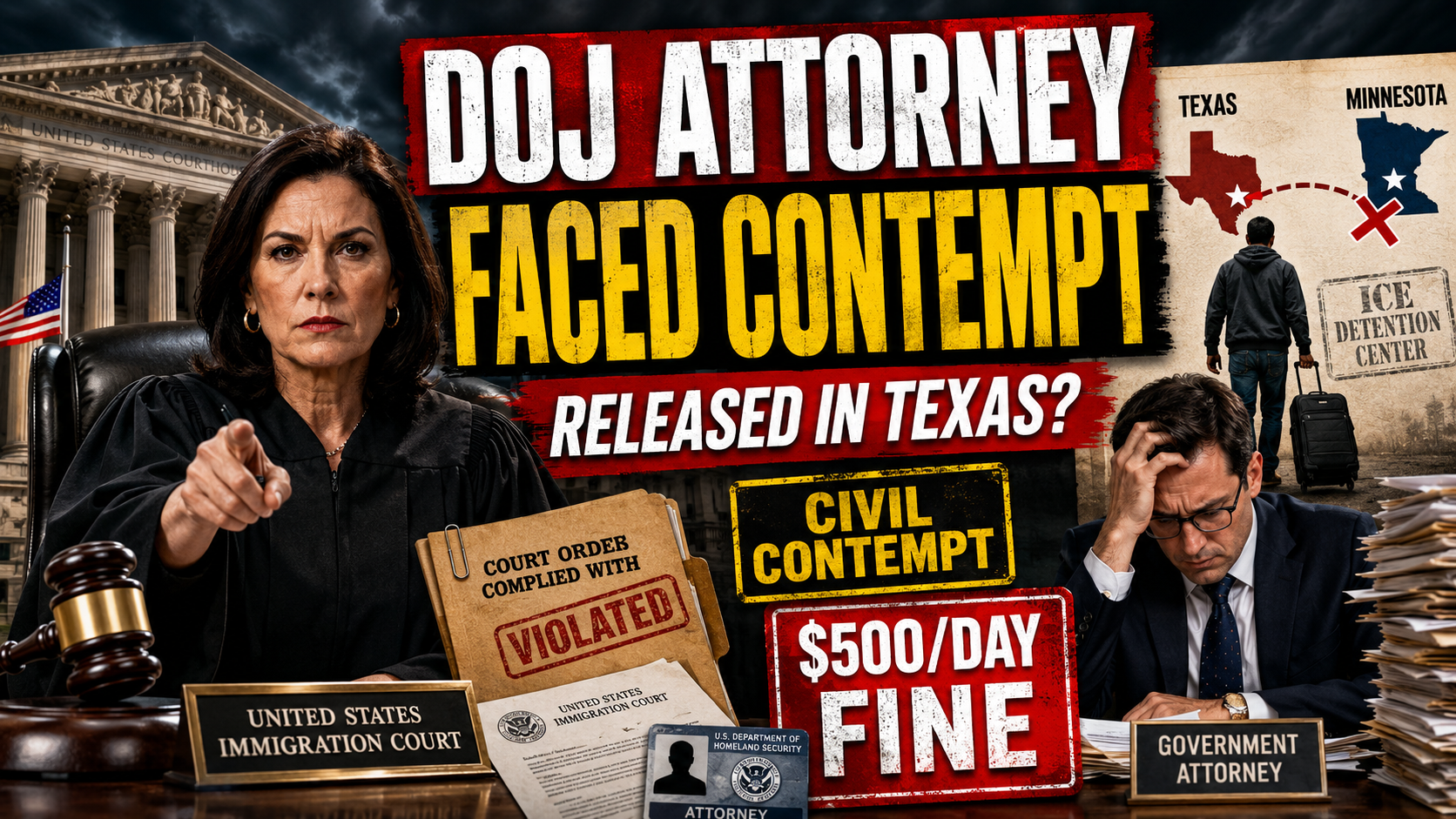
Why Did the DOJ Attorney Face Contempt Charges?
A Justice Department attorney faced contempt proceedings because a federal judge found that he failed to act on a clear court order in an immigration detention case.
Special Assistant U.S. Attorney Matthew Isihara was assigned to represent the federal government in the case of Rigoberto Soto Jimenez. Judge Laura M. Provinzino had ordered the government to release Soto Jimenez in Minnesota, return all his property, and file a report confirming compliance.
Instead, Soto Jimenez was released in Texas without several identification documents. The government also failed to submit the required status report. Judge Provinzino concluded that Isihara knew about the order but did not take reasonable steps to ensure it was carried out.
Quick Answer
The DOJ attorney faced civil contempt because the court found that he:
- Missed the deadline to respond to the detainee’s petition.
- Received the release order but did not properly notify ICE.
- Failed to ensure the detainee was released in Minnesota.
- Did not act after learning that identification documents were missing.
- Failed to provide the court with the required compliance report.
- Did not show that following the order was impossible.
The judge imposed a conditional fine of $500 per day, but the documents were returned before any fines became payable.
Were These Criminal Contempt Charges?
No. Describing the matter as “contempt charges” can create the wrong impression.
Isihara was not criminally prosecuted or charged with a crime. He was found in civil contempt of court during a federal habeas corpus case.
Civil contempt is normally used to make someone comply with an existing court order. Criminal contempt, by comparison, punishes completed misconduct and can result in a fixed fine or imprisonment.
The sanction against Isihara was conditional. He could avoid the fine by helping secure the return of Soto Jimenez’s documents. That is why the proceeding was civil rather than criminal.
How the Immigration Case Began
Soto Jimenez filed a petition for a writ of habeas corpus on February 2, 2026.
A habeas petition allows a detained person to ask a federal court to examine whether the government has legal authority to keep that person in custody.
Judge Provinzino ordered the government to respond by February 5. According to her later written decision, the deadline passed without a government response.
On February 9, the judge granted relief and ordered the government to:
- Release Soto Jimenez in Minnesota by February 13.
- Return all property belonging to him.
- File a compliance update by 3:00 p.m. on February 17.
The order was specific about both the location of the release and the return of his belongings.
What Went Wrong After the Release Order?
Soto Jimenez was released on February 12, but he was released in Texas rather than Minnesota.
The government also retained several identity documents:
- His Minnesota driver’s license.
- His Minnesota instruction permit.
- His Mexican consular identification card.
The court stated that Soto Jimenez spent a night in a shelter because he was released in an unfamiliar state without identification. His attorney arranged his flight back to Minnesota using donated airline miles.
The federal government did not provide the court with its required status update. Soto Jimenez’s attorney informed the judge about the release and the missing property after the government’s reporting deadline had passed.
What Was Isihara Expected to Do?
As the government attorney assigned to the case, Isihara was responsible for handling the federal response and communicating relevant court orders to immigration officials.
The court found that Isihara received the February 9 order from paralegals in the U.S. Attorney’s Office. He admitted that the normal procedure would have been to send the order to ICE.
According to the judge, he did not do so.
The written decision also states that:
- He did not prepare the required response to the habeas petition.
- He did not take steps to ensure ICE received and followed the release order.
- He did not follow up after Soto Jimenez’s lawyer contacted him on February 12.
- He did not respond when the lawyer contacted him again about the missing property on February 16.
- He began substantive work on the matter on the morning of the February 18 contempt hearing.
Judge Provinzino concluded that Isihara had received several warnings but had still taken no meaningful corrective action before the hearing.
Why Did the Judge Schedule a Contempt Hearing?
After learning that her instructions had not been fully followed, Judge Provinzino ordered the government to appear at a show-cause hearing.
A show-cause hearing gives the affected party a chance to explain why the judge should not impose sanctions.
The court directed ICE to send a representative who:
- Knew about the release order.
- Understood Soto Jimenez’s custody and release.
- Knew what had happened to his property.
- Could explain why he was released in Texas.
The ICE official who appeared had reportedly learned about the case only that morning. The government’s representatives could not give the judge a clear account of who authorized the Texas release or where the missing documents were located.
Why Was Isihara Personally Held Responsible?
A government attorney does not physically release detainees or store their property. That raises a fair question: why sanction the lawyer rather than ICE?
Judge Provinzino’s reasoning was that Isihara was the attorney assigned to the case and had direct notice of the court’s order. His professional responsibility included communicating that order and alerting the court if compliance problems arose.
The judge found that he did neither.
Her written decision stated that the available evidence made Isihara appear most responsible for the continued noncompliance. However, she also acknowledged that other officials might have shared responsibility. The government’s failure to present a knowledgeable ICE witness prevented the court from determining the full chain of responsibility.
This distinction matters. The court did not conclude that Isihara personally decided to release Soto Jimenez in Texas or personally withheld the documents. It found that he failed to perform the actions expected of the government lawyer responsible for the case.
Why Was the Heavy Workload Defense Rejected?
Isihara explained that the matter had fallen through the cracks during a period of severe workload pressure.
The court recognized that he had recently joined the U.S. Attorney’s Office, had little prior federal court experience, and had been assigned nearly 130 cases.
Judge Provinzino nevertheless rejected understaffing as a sufficient defense.
Her concern was not merely that Isihara made an isolated mistake. The court found that he:
- Knew about the order.
- Had more than one opportunity to address the problem.
- Did not request additional time.
- Did not notify the court that compliance was at risk.
- Did not explain what corrective steps were underway.
- Did not respond promptly to opposing counsel.
The judge stated that government lawyers should immediately inform the court when an order has been or may be violated. She indicated that prompt disclosure and corrective action would usually weigh against sanctions. What the court would not accept was noncompliance combined with silence.
What Must a Court Find for Civil Contempt?
In this case, Judge Provinzino focused on three central points:
- The court issued a clear and specific order.
- Isihara had notice of that order.
- He failed to take steps to comply and did not show that compliance was impossible.
The court therefore determined that a coercive civil sanction was appropriate.
Civil contempt is not supposed to punish an unavoidable failure. A person generally must have the ability to comply or help bring about compliance.
What Sanction Did the Judge Impose?
Judge Provinzino ordered a fine of $500 for each day after February 19 that Soto Jimenez remained without his identification documents.
The amount was not immediately payable. It would begin accumulating only if the documents remained missing beyond the stated deadline.
The judge said she considered:
- The seriousness of the harm.
- Whether the sanction was likely to produce compliance.
- The financial burden created by the fine.
The sanction focused on the missing identification because those documents were necessary for ordinary activities such as travel, employment, housing, banking, and proving identity.
Did the DOJ Attorney Pay Any Fine?
No.
The government returned Soto Jimenez’s property on February 19 and filed a declaration confirming compliance.
Judge Provinzino then ruled that Isihara had purged the contempt. This means the violation had been corrected for purposes of the coercive sanction.
Because the documents were returned before the daily penalty began, no fines were imposed.
It would therefore be inaccurate to say that Isihara was fined $500. The court threatened a $500-per-day sanction, but he did not ultimately have to pay it.
Civil Contempt vs. Criminal Contempt
| Civil contempt | Criminal contempt |
|---|---|
| Seeks compliance with an order | Punishes past disobedience |
| Usually conditional | Usually carries a fixed penalty |
| Can end when compliance occurs | Punishment remains after compliance |
| May involve daily fines | May involve fines or imprisonment |
| Is not necessarily a criminal conviction | Can result in criminal consequences |
Isihara’s case involved civil contempt because the sanction would disappear once the required documents were returned.
Why the Missing Documents Mattered
The dispute may sound like a technical argument over property, but identification documents have major practical value.
Someone without valid identification may struggle to:
- Board a flight.
- Check into a hotel.
- Obtain employment.
- Rent a home.
- Access a bank account.
- Receive some forms of medical care.
- Prove their identity to government officials.
Soto Jimenez was released far from Minnesota without the documents normally needed to arrange safe travel home. The court therefore treated the missing property as a serious consequence rather than a minor administrative error.
What the Case Was Really About
The contempt proceeding was not a ruling on national immigration policy.
It concerned a narrower question: What happens when the federal government receives a clear judicial order but fails to carry it out or explain why it cannot do so?
The court’s position was that government lawyers have two basic choices:
- Follow the order.
- Promptly tell the judge why compliance is not possible and what is being done to fix the problem.
According to Judge Provinzino, the government did neither in this case.
Frequently Asked Questions
Who was the DOJ attorney?
Matthew Isihara was serving as a Special Assistant U.S. Attorney assigned to the immigration habeas case.
Why did he face contempt proceedings?
The judge found that he knew about a release and property-return order but did not take timely steps to communicate it, enforce compliance, or warn the court about the problem.
Was Isihara criminally charged?
No. He was found in civil contempt. The proceeding did not result in a criminal conviction.
Was Soto Jimenez released from custody?
Yes, but he was released in Texas instead of Minnesota and without several identification documents.
Why was a daily fine used?
A daily fine creates pressure to correct an ongoing violation. It ends or never takes effect once compliance occurs.
Did Isihara pay the fine?
No. The government returned the documents before the fine began accumulating.
Did the contempt finding decide Soto Jimenez’s immigration status?
No. The contempt dispute addressed compliance with the release order. It did not itself grant permanent legal status or resolve every possible immigration proceeding.
Final Thoughts
The DOJ attorney faced civil contempt because Judge Laura Provinzino found more than a simple missed deadline.
The assigned lawyer received a clear court order, failed to send it through the normal process, did not respond effectively when warned about noncompliance, and did not update the court. Meanwhile, the detained man was released in the wrong state without important identity documents.
The court used a conditional daily fine to force a solution. Once the government returned the property, no fine was collected.
The case reinforces a basic rule of litigation: being overloaded may explain a mistake, but it does not erase an attorney’s duty to communicate with the court and take prompt action when a judicial order has not been followed.
Disclaimer
This article is for general informational purposes only. It summarizes a publicly available federal court order and does not provide legal advice. Court rulings may later be appealed, modified, or clarified. Readers dealing with a specific immigration or contempt matter should consult official court records and a qualified attorney.