
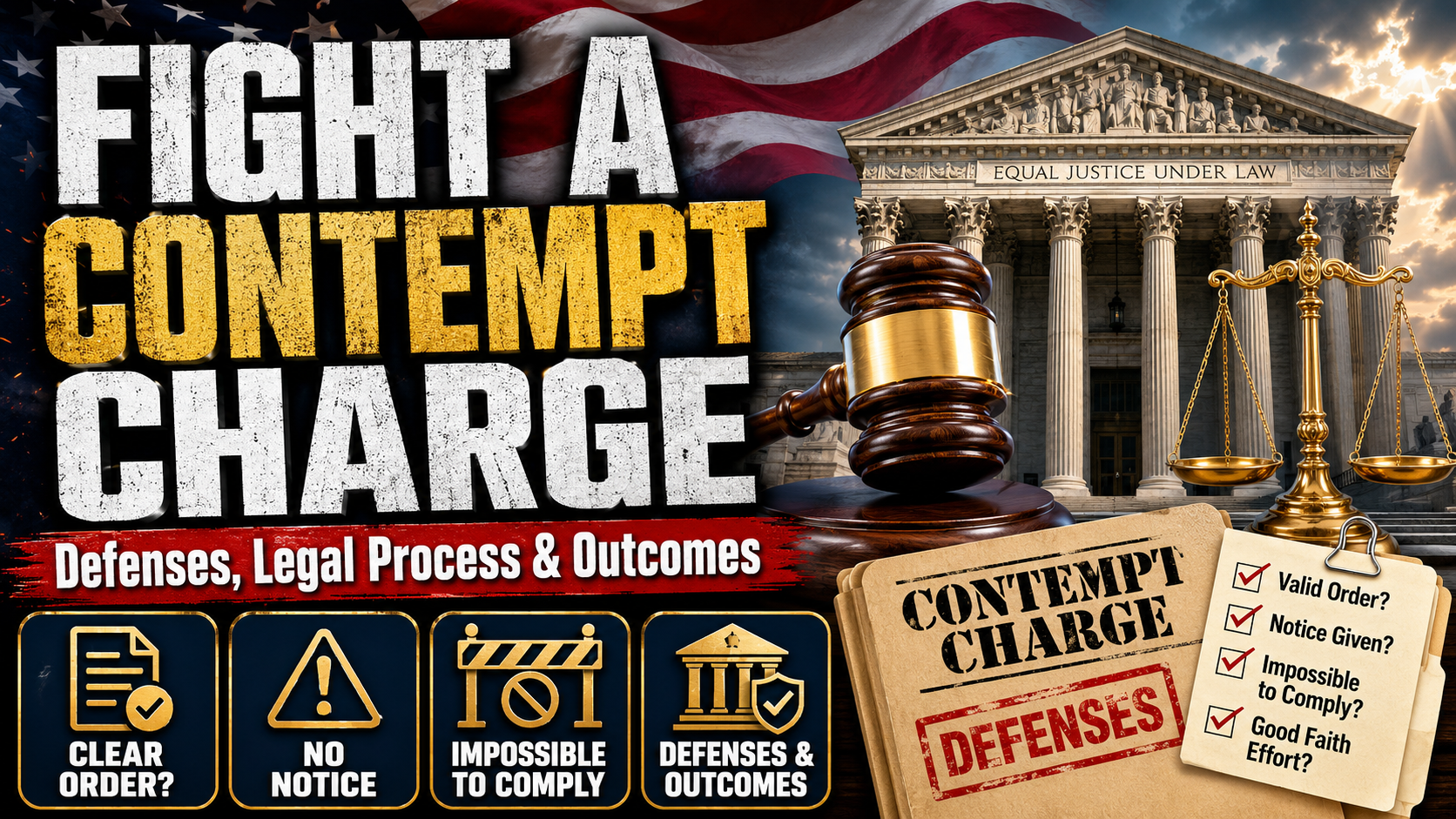
How to Fight a Contempt Charge: Defenses, Legal Process, and Possible Outcomes
A contempt charge can be stressful because it means a court believes someone may have failed to follow a legal order or interfered with court authority. However, being accused of contempt does not automatically mean a person will be found responsible.
The way to fight a contempt charge depends on the facts of the case, the type of contempt involved, and the laws of the jurisdiction. Common approaches include challenging whether a valid court order existed, showing that compliance was impossible, proving a misunderstanding, or demonstrating that the requirements for contempt were not met.
Understanding the process and possible defenses can help people respond properly instead of ignoring the situation.
What Is a Contempt Charge?
A contempt charge is a legal action claiming that someone failed to follow a court order or disrupted the authority of the court.
Contempt generally falls into two categories:
Civil Contempt
Civil contempt is usually designed to encourage compliance with a court order.
Examples:
- Failure to pay court-ordered support
- Refusing to provide required documents
- Violating a custody or visitation order
- Ignoring a court instruction
The person may avoid further consequences by following the court’s requirements.
Criminal Contempt
Criminal contempt is usually intended to punish conduct that disrespects or obstructs the court.
Examples:
- Disrupting courtroom proceedings
- Threatening court officials
- Intentionally interfering with court operations
Criminal contempt may involve penalties similar to other criminal matters.
How to Fight a Contempt Charge
The best defense depends on the specific circumstances. A person accused of contempt may challenge different parts of the claim.
1. Show That There Was No Clear Court Order
A contempt finding usually requires a valid and understandable court order.
A possible defense is that:
- The order was unclear
- The instructions were confusing
- The person misunderstood what was required
- The order did not apply to them
Courts generally expect orders to provide enough information for someone to know what action is required.
2. Prove You Did Not Know About the Order
A person may argue that they were not properly informed about the court order.
For example:
- They were never served with the order
- They did not receive proper notice
- They were unaware of a hearing decision
Knowledge of the order is often an important issue in contempt cases.
3. Show That Compliance Was Impossible
One possible defense is proving that following the order was not possible.
Examples:
- Lack of financial ability to make a required payment
- No access to documents requested by the court
- Circumstances outside the person’s control
However, simply saying compliance was difficult is usually not enough. Courts often look for evidence showing genuine inability.
4. Demonstrate Good Faith Efforts to Comply
A person may defend against contempt by showing they tried to follow the court’s instructions.
Examples:
- Attempting to make required payments
- Contacting the court about problems
- Requesting additional time
- Taking steps to correct mistakes
Evidence of responsible action can help show that the violation was not intentional.
5. Challenge the Evidence
The person bringing the contempt claim usually must provide evidence.
A defense may involve showing:
- The alleged violation did not happen
- Records are incorrect
- The facts were misunderstood
- The evidence does not prove a violation
Documents, messages, receipts, and court records may be important.
Steps to Take After Receiving a Contempt Charge
1. Read the Court Documents Carefully
Review:
- The contempt motion
- The original court order
- Hearing notices
- Supporting evidence
Understanding the exact allegation is the first step.
2. Do Not Ignore the Hearing
Missing a contempt hearing can make the situation worse.
The court may proceed without your explanation and make decisions based on available information.
3. Collect Supporting Evidence
Useful evidence may include:
- Emails or messages
- Payment records
- Documents showing compliance
- Medical or employment records when relevant
- Previous court communications
Evidence should directly address the reason for the alleged violation.
4. Consider Legal Representation
Contempt proceedings can have serious consequences. A lawyer can help:
- Review the court order
- Identify possible defenses
- Prepare evidence
- Explain local procedures
Legal options vary by location, so professional advice may be important.
Common Defenses Against Contempt Charges
| Defense | Explanation |
|---|---|
| No valid order | The court order was missing, invalid, or unclear |
| Lack of notice | The person did not know about the order |
| Impossibility | Compliance was not realistically possible |
| Compliance already occurred | The person followed the order |
| Lack of evidence | The violation was not proven |
| Mistake or misunderstanding | The failure was not intentional |
The success of any defense depends on the facts and applicable law.
What Happens During a Contempt Hearing?
A contempt hearing allows the court to review the allegations.
The process may include:
- The accusation being presented
- Evidence being reviewed
- The accused person responding
- Witness testimony, if needed
- The judge making a decision
The judge may decide:
- No contempt occurred
- The person must correct the violation
- Penalties are appropriate
- Additional hearings are needed
What Happens If You Lose a Contempt Case?
The consequences depend on whether the contempt is civil or criminal.
Possible outcomes include:
Civil Contempt Consequences
- Order to comply
- Fines
- Payment of costs
- Additional court supervision
Criminal Contempt Consequences
- Fines
- Jail time
- Other criminal penalties
The exact consequences depend on jurisdiction and the details of the case.
Mistakes to Avoid When Fighting Contempt
Some actions can damage a defense.
Avoid:
- Ignoring court notices
- Refusing to appear at hearings
- Destroying documents
- Making unsupported claims
- Assuming the court order does not matter
- Waiting until the last minute to respond
Taking the issue seriously early can make a significant difference.
Can You Appeal a Contempt Decision?
In many jurisdictions, a person may have options to challenge a contempt decision.
Possible options may include:
- Filing an appeal
- Requesting review
- Asking for reconsideration
The availability of these options depends on:
- The type of contempt
- The court involved
- Local procedural rules
Frequently Asked Questions
Can a contempt charge be dismissed?
Yes, a contempt charge may be dismissed if the court finds that the legal requirements were not met or the evidence does not support the allegation.
Is contempt a criminal offense?
It depends on the type. Civil contempt is generally focused on enforcement, while criminal contempt may involve punishment.
Can someone avoid contempt by complying with the court order?
In many civil contempt cases, compliance can resolve the issue, but the final outcome depends on the judge’s order and applicable law.
What is the strongest defense against contempt?
There is no single strongest defense. The best defense depends on whether the issue involves lack of notice, unclear orders, inability to comply, or insufficient evidence.
Can an attorney be charged with contempt?
Yes. Attorneys can face contempt proceedings if they fail to follow valid court orders or interfere with court authority.
Final Thoughts
Fighting a contempt charge requires understanding the court order, responding properly, and presenting evidence that explains what happened.
A contempt allegation is serious, but the court must consider whether the legal requirements have been met. Strong responses usually focus on facts, evidence, and compliance rather than ignoring the accusation.
Anyone facing a contempt matter should review the situation carefully and consider obtaining legal guidance based on their specific circumstances.