
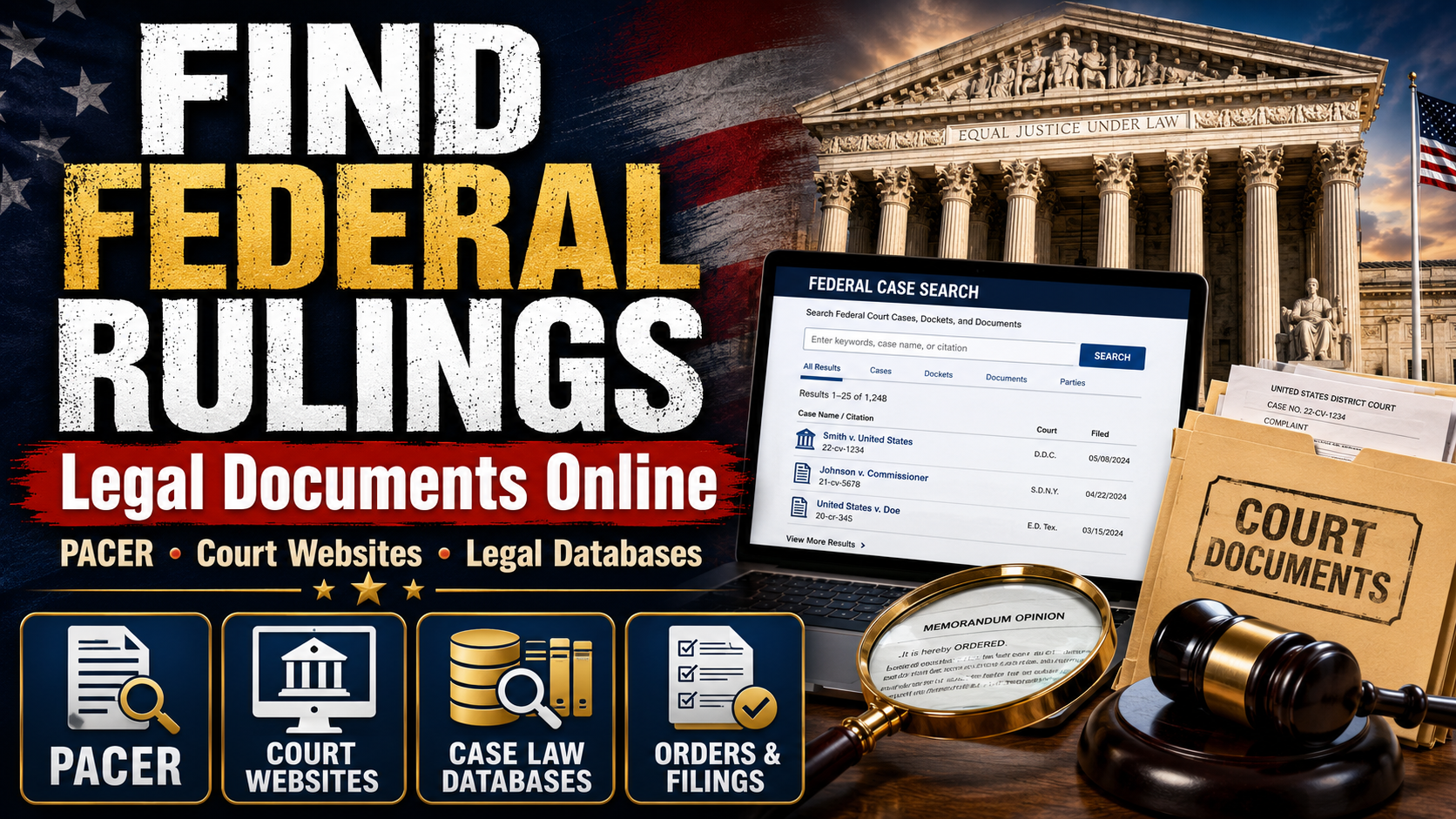
How to Find Federal Rulings and Legal Documents Online
Finding federal rulings and legal documents can seem difficult, especially for people who are not familiar with the court system. Federal cases involve thousands of filings, opinions, orders, and records, and knowing where to search makes the process much easier.
Federal court documents are public records in most situations. They can provide important information about lawsuits, judicial decisions, court procedures, and legal arguments.
You can find federal rulings and legal documents through official government sources, court databases, and trusted legal research platforms. The right method depends on whether you need a recent court order, a full case file, or a specific judge’s decision.
What Are Federal Court Rulings and Legal Documents?
Federal court rulings are decisions issued by federal judges. These decisions explain how a court resolved a legal issue or dispute.
Common federal court documents include:
- Court opinions
- Written orders
- Judgments
- Motions
- Briefs
- Complaints
- Responses from opposing parties
- Hearing transcripts
- Case filings
Some documents explain the judge’s reasoning, while others show the arguments made by lawyers involved in the case.
Where Can You Find Federal Court Rulings?
Several sources provide access to federal legal documents.
1. PACER (Public Access to Court Electronic Records)
PACER is the official electronic system used to access federal court records in the United States.
You can use PACER to search for:
- Federal civil cases
- Criminal cases
- Bankruptcy cases
- Court filings
- Judicial orders
- Case histories
PACER allows users to search by:
- Party name
- Case number
- Court location
- Filing date
It is one of the most complete sources for federal case documents.
2. Court Websites
Individual federal courts often publish selected documents and opinions on their websites.
You may find:
- Recent opinions
- Court announcements
- Local rules
- Judicial information
- Filing instructions
However, not every document from every case appears on a court website.
3. Federal Court Opinion Databases
Several legal research websites collect federal opinions and make them easier to search.
Common sources include:
- CourtListener
- Google Scholar Case Law Search
- Legal Information Institute (LII)
These platforms can be useful for finding published opinions and understanding legal decisions.
How to Search for a Federal Court Ruling
A good search usually requires specific information.
Useful details include:
- Case name
- Judge’s name
- Court name
- Case number
- Legal issue
- Date of decision
For example, instead of searching:
“immigration case ruling”
a more effective search may be:
“Judge Laura Provinzino contempt order federal court”
Specific terms usually produce better results.
How to Find a Federal Case by Name
If you know the name of a person or organization involved in a case:
- Search the party name in a federal case database.
- Check spelling variations.
- Confirm the court location.
- Review available case documents.
Example:
A search for a company involved in a federal lawsuit may show:
- The original complaint
- Court orders
- Motions
- Final judgment
How to Find a Federal Court Order by Case Number
A case number is one of the fastest ways to locate documents.
A federal case number usually includes:
- Year filed
- Court division
- Case type
- Assigned number
Example format:
1:26-cv-01234
To search:
- Open a federal court record database.
- Enter the case number.
- Review available filings.
- Select the document you need.
How to Find Recent Federal Court Decisions
For recent rulings, use:
- Federal court websites
- PACER
- Legal news sources
- Court opinion databases
When searching recent decisions, include:
- Judge name
- Court district
- Date range
- Legal issue
Example:
“Federal District Court order issued July 2026 immigration detention”
How to Read a Federal Court Opinion
Federal rulings often follow a standard structure.
Case Information
This section identifies:
- Parties involved
- Court
- Judge
- Case number
Background Facts
The judge explains the events that led to the dispute.
Legal Issues
This explains the questions the court must decide.
Analysis
The judge explains the law and reasoning behind the decision.
Conclusion or Order
This section states what the court decided.
Difference Between a Court Opinion and Court Order
Many people confuse these documents.
| Court Opinion | Court Order |
|---|---|
| Explains legal reasoning | Gives instructions or decisions |
| Often discusses legal principles | Usually directs specific action |
| May establish legal interpretation | Requires parties to do something |
Example:
A judge may issue an opinion explaining why a law applies, then issue an order requiring the parties to follow the decision.
How to Find Supreme Court and Appellate Court Rulings
Federal court systems include different levels.
U.S. Supreme Court
Supreme Court decisions are available through:
- Official Supreme Court website
- Legal databases
- Government archives
Federal Courts of Appeals
Appeal decisions can often be found through:
- Court websites
- PACER
- Legal research platforms
Federal District Courts
District court orders and filings are commonly accessed through PACER.
Common Mistakes When Searching Federal Legal Documents
Many people struggle because they search too broadly.
Common mistakes include:
Using General Search Terms Only
Searching:
“court ruling”
may return thousands of unrelated results.
Use specific details instead.
Confusing News Reports With Court Documents
News articles may summarize a ruling but may not contain the actual legal document.
Whenever possible, review the original court filing.
Looking at Only the Final Decision
Important information may appear in earlier filings, including:
- Motions
- Responses
- Evidence
- Judge’s reasoning
Tips for Finding Federal Legal Documents Faster
Use Exact Names
Include full names of parties and judges.
Add Court Information
Example:
“U.S. District Court Northern District of California”
Check Document Dates
A case may have multiple orders over several months or years.
Review Related Filings
A single order may make more sense when viewed with earlier documents.
Are All Federal Court Documents Public?
Many federal court records are public, but some documents may have restrictions.
Examples include:
- Sealed documents
- Certain personal information
- Confidential filings
- Protected records
Access rules can vary depending on the court and type of document.
Frequently Asked Questions
How can I find a federal court ruling for free?
You can use free sources such as court websites, CourtListener, Google Scholar case search, and other public legal databases. Some complete case files may require PACER access.
Is PACER the official source for federal court records?
Yes. PACER is the official electronic system for accessing federal court records in the United States.
Can anyone access federal court documents?
Most federal court records are available to the public, but some documents may be restricted or sealed.
How do I find a court order without a case number?
Search using the names of parties, judge name, court location, and important keywords related to the case.
How do I verify that a legal document is authentic?
The safest approach is to obtain documents from official court systems or trusted legal databases connected to the court record.
Final Thoughts
Finding federal rulings and legal documents becomes much easier when you know where to search and what information to use. Official sources like PACER provide complete federal case records, while court websites and legal databases help locate opinions and important decisions.
Using specific search details, checking original documents, and understanding different types of court filings can help anyone research federal legal matters more accurately.
Disclaimer:
The information provided in this article about finding federal rulings and legal documents is for general informational and educational purposes only. It does not constitute legal advice and should not be considered a substitute for guidance from a qualified attorney or legal professional. Court procedures, document availability, and access rules may vary depending on the court, case type, and jurisdiction. Always verify legal information through official court sources or consult a licensed attorney for advice related to a specific legal matter.