
What Happened in the Laura Provinzino Immigration Case?
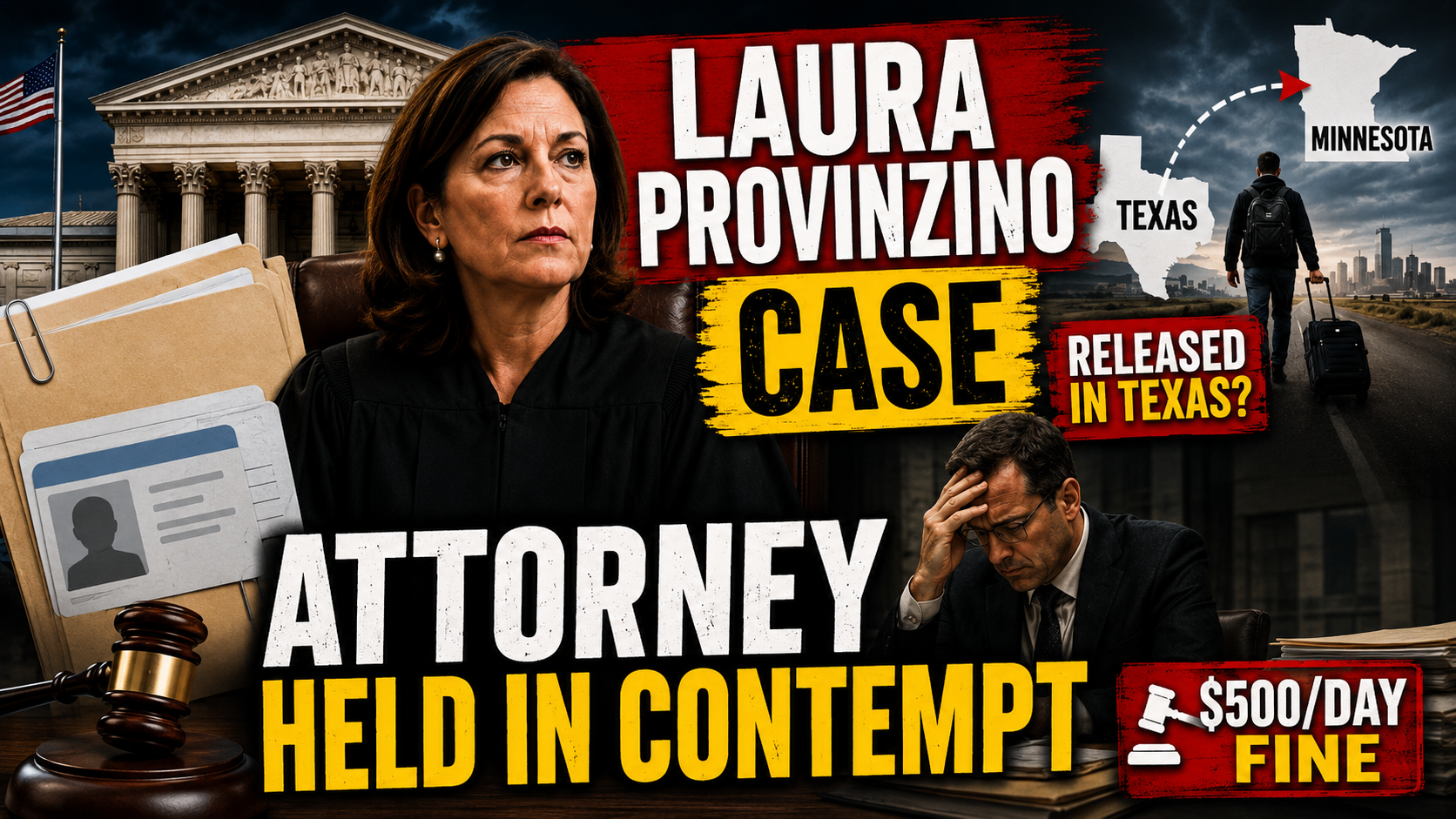
The Laura Provinzino immigration case centered on a Minnesota man named Rigoberto Soto Jimenez, who asked a federal court to review the legality of his immigration detention.
U.S. District Judge Laura M. Provinzino ordered the federal government to release him in Minnesota, return his belongings, and provide the court with an update confirming compliance. The government did not fully carry out those instructions.
Soto Jimenez was released from detention in Texas rather than Minnesota. Several identification documents were not returned to him, and the government failed to file its required status report on time.
Those failures led Judge Provinzino to hold the government attorney handling the case, Matthew Isihara, in civil contempt.
Short Explanation
Judge Laura Provinzino ordered immigration authorities to release Rigoberto Soto Jimenez in Minnesota and return all his personal property.
Instead:
- He was released in Texas.
- He did not receive several identification documents.
- The government missed a court reporting deadline.
- The attorney assigned to the case did not take timely action to correct the problem.
The judge later announced a conditional fine of $500 per day against attorney Matthew Isihara until the documents were returned. The government returned the property before the fine began accumulating.
How the Case Started
Soto Jimenez filed a petition for a writ of habeas corpus on February 2, 2026, in the U.S. District Court for the District of Minnesota.
A habeas corpus petition allows a detained person to challenge the legal basis for continued custody. It does not automatically decide whether someone may remain permanently in the United States. Instead, it asks whether the government has lawful grounds to keep that person detained.
Judge Provinzino ordered the government to respond to the petition by February 5. Court records indicate that no response was submitted by the deadline.
What Judge Provinzino Ordered
On February 9, 2026, Judge Provinzino granted relief and issued specific instructions.
The government was required to:
- Release Soto Jimenez in Minnesota.
- Return his personal property.
- Submit a report confirming compliance.
- Complete the release by the court’s stated deadline.
The location requirement was important. The order did not authorize the government to release him wherever he happened to be detained. It directed that the release take place in Minnesota.
Why His Release Created Another Problem
Immigration authorities released Soto Jimenez from a detention facility in Texas.
That meant he was left far from his Minnesota home. According to the court’s written account, he also did not receive important identification documents, including Minnesota-issued identification and a Mexican consular identification card.
His lawyer helped arrange his travel back to Minnesota. The court described how he was left without normal identification and had to rely on outside assistance after his release.
Releasing someone from custody does not necessarily solve the immediate problem when that person is:
- Hundreds of miles from home.
- Missing identification.
- Unable to arrange transportation easily.
- Without access to normal financial or travel services.
The case therefore became about both release and meaningful compliance with the judge’s full order.
The Government Failed to Update the Court
Judge Provinzino had instructed the government to submit a status report confirming that its obligations had been completed.
The report was not filed by the deadline.
Instead, Soto Jimenez’s attorney notified the court that he had been released in Texas and that some of his property remained missing.
This failure was significant because courts depend on parties to report honestly and promptly about compliance. When a deadline cannot be met, an attorney may ask for more time or explain the obstacle. Remaining silent gives the judge no reliable way to know whether the order has been followed.
Why the Court Scheduled a Contempt Hearing
After learning that the release order had not been fully carried out, Judge Provinzino ordered the government to appear at a show-cause hearing.
A show-cause hearing gives a person or organization an opportunity to explain why sanctions should not be imposed.
The judge also requested an ICE representative who understood:
- The detention.
- The release decision.
- The location of Soto Jimenez’s property.
- Why he had been released in Texas rather than Minnesota.
The court later stated that the government did not provide a witness with sufficient direct knowledge to answer those questions. Even after the hearing, the judge said she still lacked a complete explanation of who had authorized the Texas release and why the property had not accompanied him.
Why Matthew Isihara Was Held in Contempt
Matthew Isihara was serving as a Special Assistant U.S. Attorney and was responsible for handling the government’s side of the case.
Judge Provinzino found that he had received notice of the court’s order but had not taken the steps needed to ensure that ICE acted on it.
According to the written order, the court concluded that Isihara:
- Knew about the release order.
- Did not properly communicate it through the required process.
- Failed to respond adequately to messages about noncompliance.
- Did not promptly investigate the missing property.
- Took meaningful action only shortly before the hearing.
The judge found him primarily responsible based on the evidence available at that time. She also noted that others might have contributed to the failure, but the government had not provided enough informed testimony to establish who else was responsible.
Why Workload Was Not Accepted as a Full Defense
Isihara and government officials pointed to a severe immigration caseload and limited staffing in the U.S. Attorney’s Office.
The judge did not dispute that the office was under pressure. However, she rejected the idea that a heavy workload could excuse complete inaction.
The difference was not simply that the government made a mistake. The court’s concern was that the attorney:
- Did not request an extension.
- Did not warn the judge about a compliance problem.
- Did not promptly contact the responsible agency.
- Did not update the court after learning about the missing documents.
A busy attorney may still tell the court that more time is needed. Workload explains delay, but it does not automatically make a clear order optional.
What Civil Contempt Means
Civil contempt is a legal tool used to force compliance with a court order.
It is different from criminal contempt.
| Civil contempt | Criminal contempt |
|---|---|
| Seeks to obtain compliance | Punishes completed misconduct |
| May end when the order is followed | Usually involves a fixed penalty |
| Often uses conditional fines | May involve a set fine or imprisonment |
| Focuses on correcting an ongoing violation | Focuses on protecting judicial authority |
Judge Provinzino’s sanction was civil because Isihara could avoid the fine by ensuring that Soto Jimenez received his documents.
What Penalty Was Announced?
The judge announced a fine of $500 for each day Soto Jimenez remained without the required identification documents.
The fine was conditional rather than immediate. It was meant to create pressure for quick compliance.
News reports described the order as an unusual personal sanction against a government lawyer.
Did Matthew Isihara Pay the Fine?
No.
The government located and returned Soto Jimenez’s property before the daily sanction began accumulating. Judge Provinzino then recognized that the contempt had been purged, meaning the government had completed the required action and the coercive sanction was no longer necessary.
Therefore, it is misleading to say that Isihara paid a $500 fine. He faced a possible fine of $500 per day, but no amount was ultimately collected.
What Did the Case Actually Decide?
The case concerned the lawfulness of Soto Jimenez’s detention and the government’s compliance with the federal court’s release order.
It did not, by itself:
- Grant him permanent immigration status.
- End every possible immigration proceeding.
- Approve an asylum application.
- Decide whether he could never be detained again.
- Resolve any separate removal case.
Federal district courts and immigration courts perform different roles.
Judge Provinzino was acting as a federal district judge reviewing a habeas corpus petition. She was not acting as an immigration judge deciding an asylum or removal case.
Why the Case Became Important
The dispute received national attention because personally sanctioning a federal government attorney is uncommon.
It also exposed broader questions about accountability during a rapid increase in immigration detention cases:
- Who must ensure that ICE receives a federal court order?
- Can staffing shortages excuse missed deadlines?
- What should judges do when agencies do not comply?
- Should an individual attorney be sanctioned for an agency’s failure?
- How should courts protect people affected by administrative breakdowns?
The Justice Department later challenged the contempt ruling, arguing that the judge had improperly used a sanction against an attorney to force action by ICE. That appellate dispute showed that the legal controversy extended beyond the return of the documents.
A Clear Timeline
| Date | Development |
| February 2, 2026 | Soto Jimenez filed his federal habeas petition |
| February 5 | Government response deadline passed |
| February 9 | Judge ordered release in Minnesota and return of property |
| February 12 | Soto Jimenez was released in Texas |
| February 17 | Government missed the deadline for its compliance report |
| February 18 | Judge found Isihara in civil contempt |
| February 19 | The government returned the missing documents |
| February 20 | The court ended the coercive sanction without collecting fines |
The sequence is documented in the federal case docket and Judge Provinzino’s written order.
Frequently Asked Questions
Who was involved in the Laura Provinzino immigration case?
The petitioner was Rigoberto Soto Jimenez. Judge Laura M. Provinzino handled his federal habeas corpus case, while Matthew Isihara represented the government as a Special Assistant U.S. Attorney.
Why did the judge order Soto Jimenez’s release?
Judge Provinzino granted relief after the government failed to submit its response within the deadline set by the court.
Why was releasing him in Texas considered noncompliance?
The written order required the government to release him in Minnesota. A release in Texas did not satisfy that part of the court’s instructions.
What belongings were not returned?
The written order identified several forms of identification, including Minnesota documents and a Mexican consular identification card.
Why was the government attorney blamed?
The judge found that Isihara knew about the order but failed to take timely steps to communicate it, monitor compliance, respond to warnings, or update the court.
Was Isihara charged with a crime?
No. Civil contempt is not the same as a criminal conviction.
Was the contempt ruling permanent?
The practical sanction ended after the government returned the property. However, the Justice Department continued challenging the legal basis of the contempt ruling on appeal.
Final Thoughts
The Laura Provinzino immigration case was not just a dispute about delayed paperwork.
A federal court ordered the government to release a detained man in Minnesota, return his belongings, and report back. He was instead released in Texas without key identification documents, while the required court update was missed.
Judge Provinzino concluded that the assigned government lawyer had failed to take reasonable steps to secure compliance. Her civil contempt order was designed to make the government act, not to impose criminal punishment.
The property was returned quickly after the contempt finding, and no fine was collected. Even so, the case left a larger unresolved question: how courts should assign responsibility when individual lawyers, federal agencies, and overloaded government offices all play a role in disobeying a judicial order.
Disclaimer
This article is provided for general information and education. It summarizes publicly available court records and reporting and does not offer legal advice. Court rulings can be appealed, modified, or clarified through later proceedings. Anyone seeking guidance about a specific immigration or federal court matter should consult official records and a qualified attorney.