
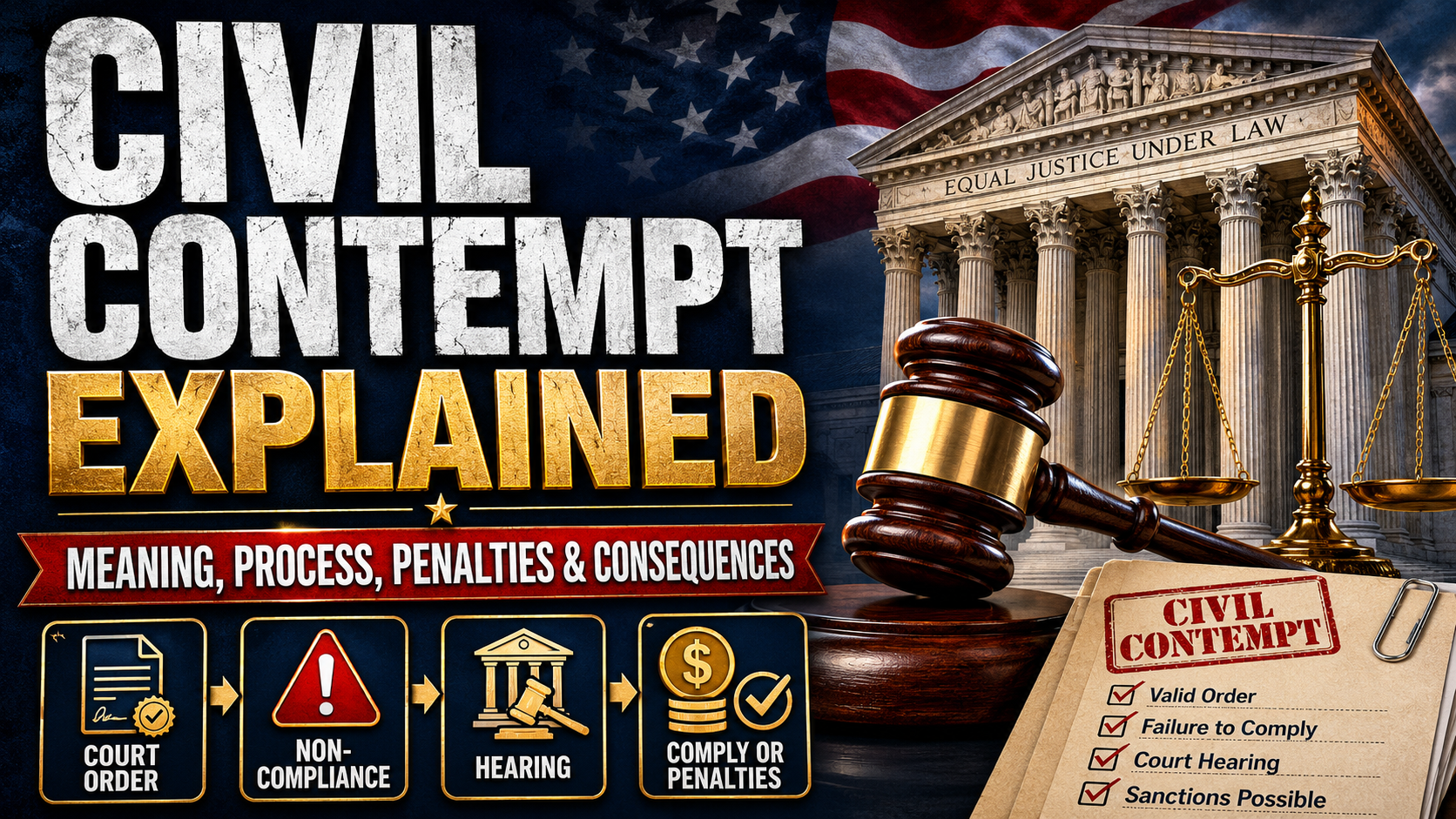
Civil Contempt Explained: Meaning, Process, Penalties, and Legal Consequences
Civil contempt is a legal tool courts use to enforce compliance with a court order or protect the rights of a person involved in a legal case. It happens when someone fails to follow a court’s instruction, but the main purpose is usually to make them comply rather than punish them for wrongdoing.
Unlike criminal contempt, which focuses on punishing disrespect toward the court, civil contempt is often designed to solve a problem. A judge may use civil contempt to encourage a person to take a required action, such as paying support, providing documents, or following a custody order.
Understanding how civil contempt works helps explain how courts enforce their decisions and what consequences may follow when someone ignores a judge’s order.
What Is Civil Contempt?
Civil contempt occurs when a person does not comply with a valid court order and the court takes action to force compliance.
A court order may require someone to:
- Pay child support or alimony
- Follow a custody or visitation schedule
- Provide legal documents or evidence
- Stop a specific action
- Complete a required legal step
- Follow terms of a settlement agreement
If the person refuses or fails to follow the order, the other party may ask the court to intervene.
The judge may then hold a civil contempt hearing to determine whether enforcement action is necessary.
How Does Civil Contempt Work?
Civil contempt generally follows a legal process.
1. A Court Order Exists
The first requirement is usually a valid court order.
The order must clearly explain what the person is required to do.
Example:
A judge orders a parent to pay monthly child support. If the parent refuses to make payments despite having the ability to do so, the court may consider civil contempt.
2. Someone Fails to Follow the Order
The person must have failed to comply with the court’s instructions.
The failure may involve:
- Not completing a required action
- Ignoring deadlines
- Refusing to provide information
- Continuing behavior prohibited by the court
3. A Motion for Contempt Is Filed
The person affected by the violation may file a request asking the court to enforce the order.
The filing usually explains:
- What the court ordered
- How the order was violated
- Evidence showing non-compliance
- What action the court should take
4. The Court Holds a Hearing
During a civil contempt hearing, the judge reviews evidence from both sides.
The person accused of contempt may have the opportunity to explain:
- Why they did not comply
- Whether they misunderstood the order
- Whether they were unable to follow it
- Whether they have corrected the problem
The judge then decides what action is appropriate.
What Are the Requirements for Civil Contempt?
The exact requirements vary by jurisdiction, but courts generally look at several important factors.
| Requirement | Explanation |
|---|---|
| Valid court order | A lawful and enforceable order must exist |
| Knowledge of the order | The person must know about the requirement |
| Failure to comply | The person did not follow the instruction |
| Ability to comply | The person had the ability to follow the order |
| Court authority | The court must have power over the matter |
A person usually cannot be held in civil contempt for failing to do something impossible.
For example, a court may consider whether someone genuinely lacked the ability to comply with an order.
Civil Contempt vs Criminal Contempt
Civil and criminal contempt are related but serve different purposes.
| Civil Contempt | Criminal Contempt |
|---|---|
| Focuses on enforcing compliance | Focuses on punishment |
| Usually benefits another party | Protects the authority of the court |
| Person may avoid consequences by complying | Punishment may continue after compliance |
| Often involves court orders | May involve disrespectful or disruptive conduct |
Example:
A person who refuses to pay court-ordered support may face civil contempt because the goal is to encourage payment.
A person who threatens a judge during a hearing may face criminal contempt because the conduct challenges court authority.
What Happens After a Civil Contempt Finding?
The consequences depend on the situation and local law.
Possible outcomes include:
Court Orders Compliance
The judge may order the person to complete the required action.
Example:
A court may require someone to provide missing documents within a specific timeframe.
Fines
A court may impose financial penalties in some situations.
The purpose is often to encourage compliance or compensate for costs caused by the violation.
Attorney Fees and Costs
In some cases, the court may order the violating party to pay legal expenses caused by the failure to comply.
Jail as a Last Resort
Some civil contempt cases can involve jail until the person complies with the court order.
This is different from a criminal sentence because the person may be released after following the court’s requirement.
Example:
A person who refuses to provide information ordered by the court may remain detained until they comply.
Rules regarding this vary significantly by jurisdiction.
Examples of Civil Contempt
Example 1: Child Support Order
A court orders someone to pay monthly child support. The person has income but refuses to pay.
The other parent requests enforcement. The court may use civil contempt to encourage payment.
Example 2: Failure to Follow Custody Order
A parent repeatedly refuses to follow a court-approved visitation schedule.
The other parent may ask the court to enforce the custody order.
Example 3: Ignoring Discovery Requirements
During a lawsuit, a court orders a party to provide specific documents.
The party refuses without a valid reason.
The court may use civil contempt procedures to require compliance.
Can an Attorney Be Held in Civil Contempt?
Yes. Attorneys can face civil contempt if they fail to follow valid court orders.
Examples may include:
- Ignoring discovery orders
- Missing required court deadlines
- Failing to submit ordered documents
- Refusing to follow judicial instructions
However, courts usually examine the specific circumstances before imposing consequences.
An attorney’s professional status does not exempt them from court authority.
How Can Someone Defend Against Civil Contempt?
A person accused of civil contempt may raise several arguments, depending on the facts.
Possible defenses include:
- They did not know about the order
- The order was unclear
- Compliance was impossible
- They attempted to comply
- The violation was caused by circumstances outside their control
The strength of any defense depends on evidence and applicable law.
Common Mistakes That Lead to Civil Contempt
Many contempt issues happen because people underestimate court orders.
Common mistakes include:
- Ignoring court deadlines
- Assuming an order is optional
- Failing to communicate problems to the court
- Not requesting a modification when circumstances change
- Waiting too long to correct a violation
If someone cannot comply with a court order, the proper approach is usually to seek court relief rather than ignore the requirement.
Frequently Asked Questions
Is civil contempt a criminal charge?
No. Civil contempt is generally an enforcement procedure rather than a criminal charge. However, serious situations may involve different legal consequences depending on the circumstances.
Can you go to jail for civil contempt?
In some cases, yes. A court may order detention until a person complies with a court order, but the rules vary by jurisdiction.
How long does civil contempt last?
Civil contempt may continue until the person complies with the court’s order or the court changes its decision.
Does civil contempt go on your record?
The effect depends on local laws and the type of contempt proceeding. Civil contempt is generally treated differently from a criminal conviction.
Can civil contempt be appealed?
In many jurisdictions, a person may have options to challenge a contempt order. The available process depends on local court rules.
Final Thoughts
Civil contempt is one of the ways courts enforce their authority and ensure that legal orders are followed. It is usually focused on achieving compliance rather than punishing someone.
A person facing possible civil contempt should understand the court order, review the reason for non-compliance, and respond through proper legal procedures.
Ignoring a court order rarely solves the problem. Courts expect parties, attorneys, and organizations to respect judicial decisions and take action when compliance becomes difficult.
Disclaimer:
The information provided in this article about civil contempt is for general educational and informational purposes only. It is not legal advice and should not be used as a substitute for advice from a qualified attorney. Laws, court procedures, and contempt rules vary by jurisdiction. The outcome of any legal matter depends on the specific facts and circumstances of each case. If you have questions about civil contempt or a court order issue, consult a licensed legal professional in your area.