Failure to Follow a Court Order: What It Means, Legal Consequences, and What Happens Next
A court order is a legally binding instruction issued by a judge. When someone fails to follow that order without a valid legal reason, the court may take action to enforce compliance.
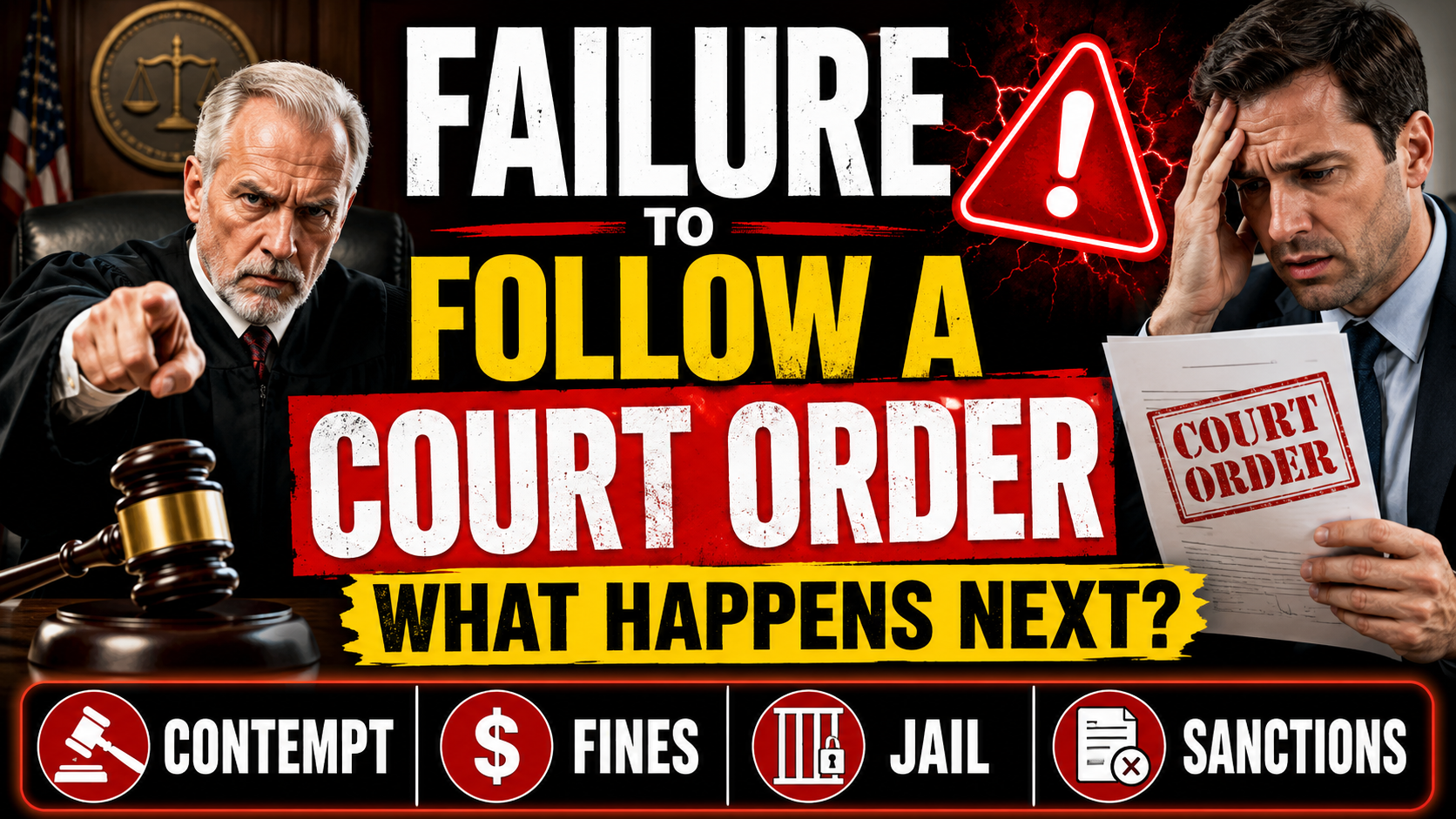
Failing to obey a court order does not always lead to immediate penalties. Courts usually consider why the order was not followed, whether compliance was possible, and whether the violation was intentional. In serious cases, however, the court may impose sanctions, fines, or hold the person in contempt.
Quick Answer
Failure to follow a court order means a person, business, or government agency does not comply with a lawful order issued by a court.
Possible consequences include:
- Being held in civil or criminal contempt
- Monetary fines
- Orders requiring immediate compliance
- Payment of legal fees in some cases
- Imprisonment in certain situations
- Additional court sanctions allowed by law
The exact consequences depend on the type of case, the nature of the violation, and the laws of the jurisdiction.
What Is a Court Order?
A court order is an official decision or direction issued by a judge that parties in a case are legally required to follow.
Court orders can cover many situations, including:
- Child custody
- Child support
- Divorce
- Property disputes
- Civil lawsuits
- Criminal cases
- Immigration matters
- Business disputes
- Injunctions
- Discovery requirements
Unless an order is modified, stayed, or overturned on appeal, it generally remains legally enforceable.
What Does It Mean to Fail to Follow a Court Order?
A person fails to follow a court order when they do not do what the judge has legally required.
Examples include:
- Ignoring a custody schedule.
- Refusing to pay court-ordered support.
- Violating a restraining order.
- Failing to return property ordered by the court.
- Missing a court-ordered deadline.
- Refusing to produce required documents.
- Ignoring an injunction.
Not every violation is intentional. Sometimes people misunderstand an order or face circumstances that make compliance impossible. Courts often consider these factors before deciding what action to take.
What Happens If Someone Ignores a Court Order?
The court may begin enforcement proceedings.
Depending on the circumstances, the judge may:
- Schedule another hearing.
- Order the person to explain the violation.
- Require immediate compliance.
- Hold the person in contempt.
- Impose fines or other sanctions.
- Take additional action allowed by law.
The response usually depends on the seriousness of the violation and whether it appears deliberate.
Can Someone Be Held in Contempt?
Yes.
One of the most common consequences of failing to follow a court order is a contempt of court proceeding.
A judge may consider contempt when:
- The order was clear.
- The person knew about the order.
- Compliance was reasonably possible.
- The person intentionally or unreasonably failed to comply.
If these elements are met, the court may conclude that contempt is appropriate.
Civil vs. Criminal Consequences
Failure to follow a court order can lead to either civil or criminal contempt, depending on the circumstances.
| Civil Contempt | Criminal Contempt |
|---|---|
| Encourages compliance | Punishes misconduct |
| Often includes conditional sanctions | Usually includes fixed penalties |
| May end after compliance | Continues even after compliance |
| Frequently used in civil cases | Common in serious or disruptive misconduct |
The procedures vary between jurisdictions.
Common Reasons People Fail to Follow Court Orders
Not every violation happens for the same reason.
Some common examples include:
- Misunderstanding the order.
- Financial hardship.
- Administrative mistakes.
- Failure to receive proper notice.
- Deliberate refusal to comply.
- Poor communication.
- Believing the order is unfair.
Even if someone believes an order is incorrect, they are generally expected to follow it unless a court changes or suspends the order.
Can Government Agencies Fail to Follow Court Orders?
Yes.
Government agencies are generally subject to the same obligation to comply with lawful court orders as private individuals and businesses.
When a federal or state agency fails to comply, judges may:
- Require explanations.
- Schedule compliance hearings.
- Order corrective action.
- Impose sanctions when legally appropriate.
One widely reported example occurred in 2026, when U.S. District Judge Laura M. Provinzino ruled that a Department of Justice attorney had failed to take reasonable steps to ensure compliance with a federal court order involving the release of an immigration detainee and the return of identification documents.
The judge issued a coercive civil contempt sanction that was later lifted after the government returned the missing documents.
The case demonstrated that courts may use enforcement powers even when the party involved is a government agency.
What If Compliance Is Impossible?
Courts generally recognize that genuine impossibility can be a defense in some situations.
For example:
- Required documents no longer exist.
- A natural disaster prevents compliance.
- A person lacks the legal ability to perform the required act.
- Another court order creates a direct legal conflict.
However, the person should normally inform the court as soon as possible rather than simply ignoring the order.
Judges often expect parties to:
- Request additional time.
- Explain the problem.
- Provide evidence.
- Seek clarification if needed.
How Can Someone Respond to a Court Order They Cannot Follow?
If compliance becomes difficult, it is usually better to address the issue before violating the order.
Possible steps include:
- Reading the order carefully.
- Consulting an attorney.
- Requesting clarification.
- Filing a motion to modify the order if permitted.
- Asking for additional time.
- Informing the court about unexpected circumstances.
Ignoring the order generally creates greater legal risk than asking the court for relief.
Frequently Asked Questions
Is failing to follow a court order illegal?
It can be. Depending on the circumstances, failing to comply with a lawful court order may result in contempt proceedings or other legal penalties.
Can someone go to jail for ignoring a court order?
Yes. In some cases, particularly involving criminal contempt or continued refusal to comply, imprisonment may be a possible consequence.
What happens if someone cannot comply?
If compliance is genuinely impossible, the person should inform the court promptly and provide evidence supporting their position. The court will decide how to proceed.
Does every violation result in contempt?
No. Courts often consider whether the violation was intentional, whether compliance was possible, and whether the person acted in good faith before deciding whether contempt is appropriate.
Can a court order be changed?
Yes. In many situations, parties may ask the court to modify or reconsider an order if circumstances change. The available procedures depend on the jurisdiction and the type of case.
Final Thoughts
Failure to follow a court order is a serious legal issue because court orders are intended to be binding on everyone involved in a case. While not every violation results in contempt or severe penalties, courts expect parties to act in good faith, communicate honestly, and seek legal relief when compliance becomes difficult.
The safest approach is to address problems early by requesting clarification, seeking legal advice, or asking the court for additional time or a modification when appropriate. Taking proactive steps often reduces the risk of more serious legal consequences.
Disclaimer
This article is for informational and educational purposes only. It explains general legal principles and should not be considered legal advice. Laws governing court orders, contempt, and enforcement vary by jurisdiction. Anyone facing issues involving a court order should consult a qualified attorney or review the applicable laws and court rules.