
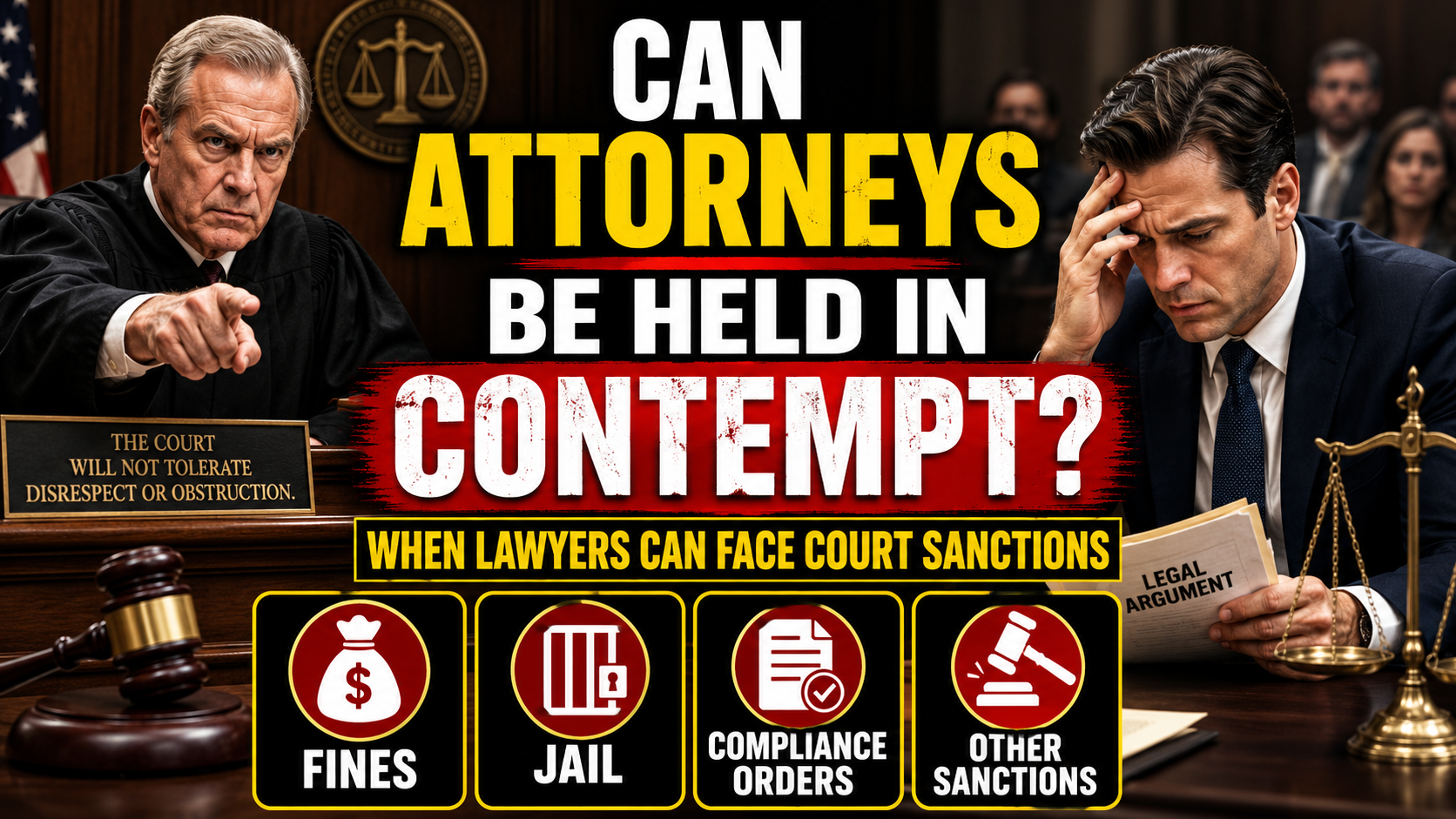
Can Attorneys Be Held in Contempt? When Lawyers Can Face Court Sanctions
Attorneys have a professional duty to follow court orders, respect courtroom procedures, and act honestly with the court. When they fail to meet those obligations, a judge may hold them in contempt under certain circumstances.
Although contempt findings against lawyers are relatively uncommon, they do happen. Courts use contempt powers to protect the judicial process, enforce lawful orders, and maintain order during legal proceedings.
Quick Answer
Yes, attorneys can be held in contempt of court. A judge may hold a lawyer in contempt if the attorney intentionally disobeys a court order, disrupts court proceedings, refuses to comply with lawful instructions, or otherwise interferes with the administration of justice.
Depending on the circumstances and the applicable law, contempt sanctions may include:
- Monetary fines
- Imprisonment
- Orders requiring compliance
- Other court-imposed sanctions
The rules and procedures vary by jurisdiction.
What Does It Mean for an Attorney to Be Held in Contempt?
A contempt finding means the court has determined that an attorney failed to respect or comply with a lawful court order or seriously interfered with the court’s ability to perform its duties.
Lawyers are officers of the court. They have professional responsibilities not only to their clients but also to the legal system itself.
This means attorneys are generally expected to:
- Follow court orders.
- Meet filing deadlines.
- Communicate honestly with the court.
- Respect courtroom procedures.
- Avoid conduct that delays or disrupts proceedings.
Failure to meet these responsibilities may result in contempt proceedings if the circumstances justify them.
Can Lawyers Be Held in Civil or Criminal Contempt?
Yes.
Depending on the situation, an attorney may face either civil contempt or criminal contempt.
Civil Contempt
Civil contempt is intended to encourage compliance with a court order.
Examples include:
- Failing to comply with a discovery order.
- Ignoring an injunction.
- Refusing to produce documents ordered by the court.
- Not taking required steps to carry out a judicial directive.
In many cases, civil contempt ends once the lawyer or the party complies with the order.
Criminal Contempt
Criminal contempt is intended to punish conduct that undermines the authority of the court.
Examples may include:
- Repeatedly interrupting court proceedings.
- Refusing to obey a judge’s direct instruction during a hearing.
- Using threatening or abusive behavior in court.
- Deliberately violating a court order after repeated warnings.
Criminal contempt usually involves separate legal procedures because it can lead to fixed penalties.
Common Reasons Attorneys Are Held in Contempt
Every case depends on its own facts, but judges have held attorneys in contempt for conduct such as:
- Ignoring a court order.
- Missing deadlines after repeated warnings.
- Refusing to comply with discovery obligations.
- Failing to appear in court without an acceptable reason.
- Disrupting courtroom proceedings.
- Refusing to stop improper questioning after a judge’s ruling.
- Violating confidentiality or protective orders.
- Disobeying injunctions issued by the court.
Not every mistake leads to contempt. Courts generally distinguish between an honest error and conduct that reflects deliberate or unreasonable noncompliance.
Can Missing a Deadline Lead to Contempt?
Sometimes, but not automatically.
Lawyers occasionally miss deadlines because of scheduling conflicts, emergencies, or administrative mistakes.
Most courts first consider:
- Whether the deadline was clear.
- Whether the attorney acted in good faith.
- Whether the lawyer requested an extension.
- Whether the delay harmed the case.
- Whether the attorney promptly corrected the problem.
A single missed deadline often results in another type of court sanction rather than contempt. However, repeated failures or knowingly ignoring court orders may increase the likelihood of contempt proceedings.
Can Government Attorneys Be Held in Contempt?
Yes.
Government lawyers generally have the same obligation as private attorneys to comply with lawful court orders.
If a court concludes that a government attorney knowingly failed to comply with a judicial order or failed to take reasonable steps to secure compliance, contempt may be considered.
One widely reported example occurred in 2026, when U.S. District Judge Laura M. Provinzino held Special Assistant U.S. Attorney Matthew Isihara in civil contempt during an immigration detention case.
The judge concluded that the government had not fully complied with a release order and had failed to return important identification documents on time. A conditional daily fine was imposed to encourage compliance. After the documents were returned, the contempt was considered purged, and no daily fines became payable.
The Department of Justice later appealed the contempt finding.
This case illustrates that courts may use contempt powers against government attorneys in unusual circumstances when they believe court orders have not been adequately carried out.
What Must a Court Usually Prove?
Although the legal standard varies by jurisdiction, courts often consider questions such as:
- Was there a clear court order?
- Did the attorney know about the order?
- Was compliance reasonably possible?
- Did the attorney intentionally or unreasonably fail to comply?
- Did the conduct interfere with the court’s authority or administration of justice?
For civil contempt, many courts also examine whether the sanction is designed to encourage compliance rather than punish past conduct.
Contempt vs. Professional Discipline
Contempt and attorney discipline are different legal processes.
| Contempt of Court | Professional Discipline |
|---|---|
| Ordered by a judge | Handled by a bar or licensing authority |
| Addresses conduct affecting a court proceeding | Addresses violations of professional ethics |
| May result in fines or imprisonment | May result in reprimand, suspension, or disbarment |
| Focuses on court authority | Focuses on professional licensing |
An attorney may face one process, both, or neither, depending on the circumstances.
How Can Attorneys Avoid Contempt?
Lawyers can reduce the risk of contempt by:
- Reading court orders carefully.
- Meeting deadlines whenever possible.
- Requesting extensions before deadlines expire.
- Informing the court immediately if compliance becomes impossible.
- Maintaining respectful courtroom conduct.
- Following judicial instructions during hearings.
- Correcting mistakes promptly.
- Communicating honestly with both the court and opposing counsel.
Most courts appreciate prompt communication when unexpected problems arise.
Frequently Asked Questions
Can an attorney really be held in contempt?
Yes. Judges may hold attorneys in contempt if they intentionally disobey court orders or seriously interfere with court proceedings.
Can a lawyer go to jail for contempt?
Yes. Depending on the type of contempt and the applicable law, imprisonment may be a possible sanction, particularly in criminal contempt cases.
Is every missed deadline contempt?
No. Courts usually consider the reasons for the delay, whether the attorney acted in good faith, and whether the lawyer attempted to correct the problem before deciding whether contempt is appropriate.
Can government lawyers be held in contempt?
Yes. Government attorneys are generally subject to the same obligation to comply with lawful court orders as other lawyers.
Does contempt mean a lawyer loses their law license?
Not necessarily. Contempt proceedings and attorney disciplinary proceedings are separate processes. A contempt finding does not automatically result in suspension or disbarment.
Final Thoughts
Attorneys are expected to uphold the law, respect judicial authority, and comply with court orders. While judges do not issue contempt findings lightly, they have the authority to do so when a lawyer’s conduct seriously interferes with the administration of justice or when lawful court orders are ignored.
Most contempt cases involving attorneys arise from repeated noncompliance, deliberate misconduct, or failure to communicate with the court. Honest mistakes are more commonly addressed through other sanctions, particularly when lawyers act quickly to correct the problem.
Understanding the difference between civil and criminal contempt helps explain why some cases focus on encouraging compliance while others are intended to punish conduct that threatens the integrity of the judicial system.
Disclaimer
This article is provided for informational and educational purposes only. It explains general legal principles and is not legal advice. Contempt laws and court procedures vary by jurisdiction. Anyone involved in contempt proceedings should consult a qualified attorney or review the applicable court rules.