
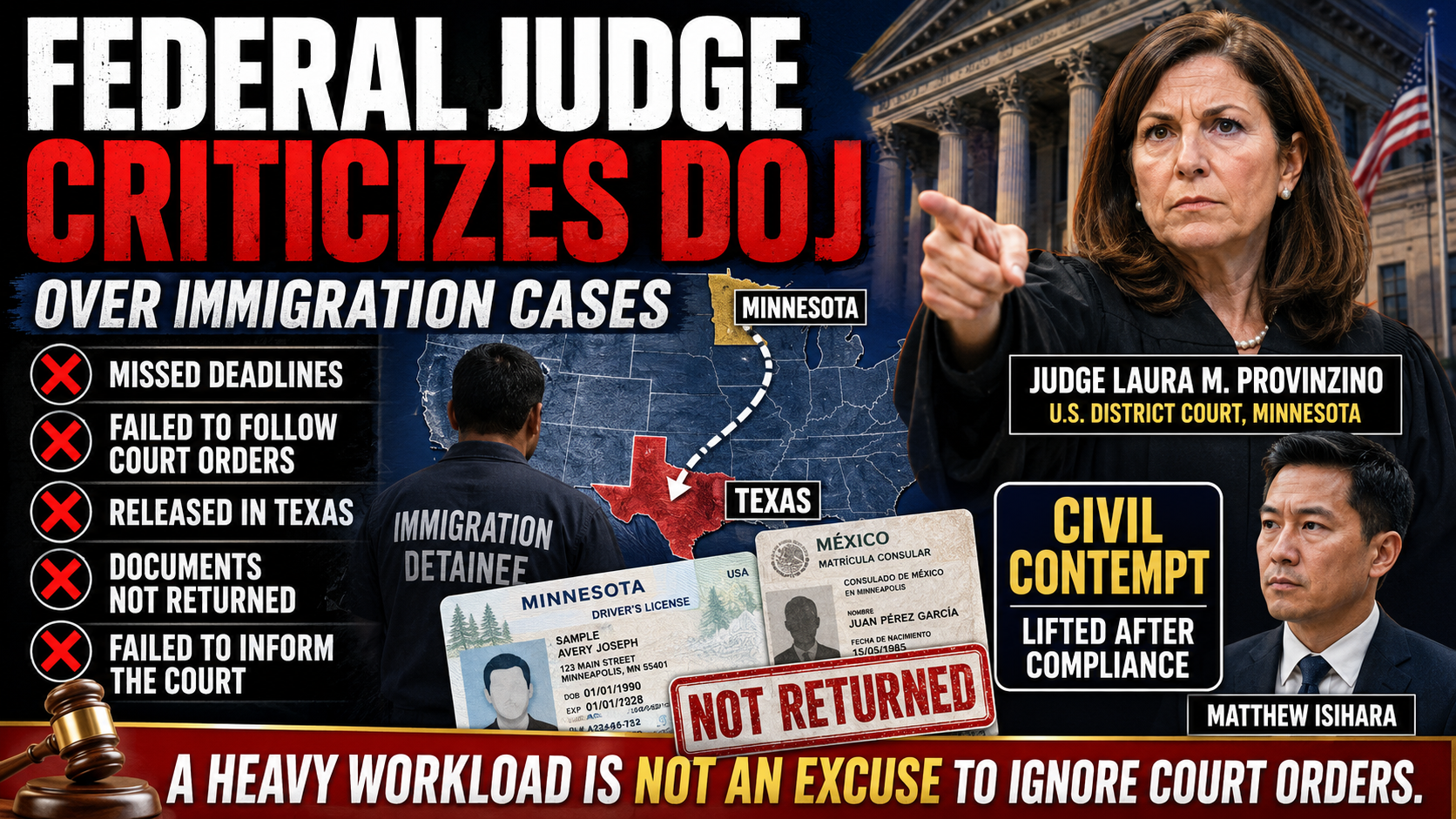
Federal Judge Criticizes DOJ Over Immigration Cases
A federal judge in Minnesota sharply criticized the Department of Justice after government lawyers repeatedly failed to meet deadlines and carry out court orders in immigration detention cases.
U.S. District Judge Laura M. Provinzino said staffing shortages and overwhelming caseloads did not excuse the government’s lack of action. Her strongest response came after a detained Minnesota resident was released in Texas without key identification documents, despite a court order requiring his release in Minnesota and the return of his property.
The dispute eventually led Provinzino to hold Special Assistant U.S. Attorney Matthew Isihara in civil contempt. The judge later lifted the coercive sanction after the documents were returned, but she continued to criticize the DOJ’s handling of immigration litigation.
Quick Answer
Judge Laura Provinzino criticized the DOJ because its attorneys failed to respond to court filings, properly communicate release orders to ICE, meet reporting deadlines, and correct known compliance problems.
The judge acknowledged that the U.S. Attorney’s Office was dealing with an extraordinary number of immigration cases. However, she ruled that a heavy workload did not allow government lawyers to ignore court orders or remain silent when those orders had not been followed.
Which Case Triggered the Judge’s Criticism?
The most prominent case involved Rigoberto Soto Jimenez, who challenged his immigration detention through a federal habeas corpus petition.
A habeas petition allows a detained person to ask a federal court to decide whether the government has legal authority to continue holding them.
Judge Provinzino ordered the government to respond to Soto Jimenez’s petition. The DOJ did not submit its response by the deadline.
The judge later granted relief and ordered the government to:
- Release Soto Jimenez in Minnesota.
- Return all property belonging to him.
- File a status report confirming compliance.
- Complete those steps within the deadlines set by the court.
The dispute grew after the government failed to carry out the instructions as written.
What Did the Government Do Wrong?
Soto Jimenez was released from immigration custody, but he was released in Texas rather than Minnesota.
He also did not receive several important identification documents, including Minnesota-issued identification and a Mexican consular card.
His lawyer had to arrange his return to Minnesota. The government then missed the deadline for filing its court-ordered compliance report.
The court learned about the release problems from Soto Jimenez’s attorney rather than from the DOJ.
This sequence concerned Judge Provinzino because the government had not merely misunderstood one minor detail. Several separate duties had been missed:
- The DOJ did not respond to the habeas petition on time.
- The release did not take place in the state specified by the court.
- The detainee’s property was not fully returned.
- The required status report was not filed.
- Government counsel did not promptly tell the court that problems had occurred.
The judge viewed the combined failures as a serious breakdown in legal responsibility.
Why Did Judge Provinzino Blame the DOJ Attorney?
Matthew Isihara was the Special Assistant U.S. Attorney assigned to represent the government.
The court found that Isihara received notice of the release order but failed to send it to ICE through the normal communication process.
According to the judge’s findings, Isihara also failed to:
- Confirm that immigration officials understood the order.
- Monitor whether the release occurred correctly.
- Respond effectively when opposing counsel reported a problem.
- Investigate the missing identification documents promptly.
- Alert the court that compliance had failed.
- Request additional time or assistance.
Isihara reportedly acknowledged that the case had fallen through the cracks and accepted responsibility for his handling of it.
However, the dispute was not based on a claim that he personally released Soto Jimenez in Texas or personally withheld his documents. The court’s criticism focused on what he failed to do as the attorney responsible for communicating and monitoring the court’s directives.
What Did the Judge Say About Staffing Shortages?
The DOJ argued that its Minnesota office was overwhelmed by a sudden rise in immigration cases.
Isihara had reportedly received a large number of assignments soon after joining the office. The surge placed major pressure on attorneys, support staff, immigration officials, and the federal courts.
Judge Provinzino did not deny that the workload was severe.
Her position was that workload problems might explain a missed step, but they could not excuse continued silence and inaction.
A lawyer who cannot meet a deadline can normally:
- Request an extension.
- Notify the court about the obstacle.
- Seek help from supervisors.
- Ask for clarification.
- Report partial compliance.
- Explain what is being done to correct the problem.
The judge found that these options had not been used in time.
Her broader message was that the government cannot create or tolerate an understaffed system and then treat the resulting failures as a complete defense to disobeying court orders.
Why Was an Emergency Hearing Held?
After learning that Soto Jimenez had been released in Texas without all his property, Judge Provinzino scheduled a show-cause hearing.
A show-cause hearing requires a person or organization to explain why the court should not impose sanctions.
The judge requested an ICE representative who understood:
- Soto Jimenez’s detention history.
- The court’s release order.
- The decision to release him in Texas.
- The location of his property.
- The communication between ICE and DOJ attorneys.
The representative who appeared had reportedly learned about the matter only shortly before the hearing and could not answer all the judge’s questions.
That lack of preparation deepened the court’s concern. It suggested that the communication failure extended beyond one missed email or one overlooked deadline.
Why Was Matthew Isihara Held in Civil Contempt?
Judge Provinzino found Isihara in civil contempt after concluding that:
- The court had issued a clear order.
- Isihara knew about the order.
- The government had not fully complied.
- Isihara had not taken adequate steps to secure compliance.
- He had not shown that compliance was impossible.
The judge announced a conditional fine of $500 per day until Soto Jimenez received his identification documents.
The sanction was intended to force corrective action. It was not a criminal prosecution or a punishment involving imprisonment.
Was the DOJ Attorney Actually Fined?
No money was ultimately collected.
The government returned the identification documents shortly after the contempt finding. Once that happened, Judge Provinzino found that the contempt had been purged and lifted the coercive sanction.
Reports that simply say Isihara “received a $500 fine” are incomplete. The order provided for a possible fine of $500 for every day of continued noncompliance, but the documents were returned before the penalty began accumulating.
Civil Contempt Was Not a Criminal Charge
The phrase “held in contempt” can sound as though Isihara was convicted of a crime. That is not what happened.
Civil contempt and criminal contempt serve different purposes.
| Civil contempt | Criminal contempt |
|---|---|
| Seeks to force compliance | Punishes past misconduct |
| Usually involves a conditional sanction | Usually involves a fixed penalty |
| Can end when the order is followed | Remains even after later compliance |
| Does not automatically create a criminal conviction | May involve criminal consequences |
The sanction in this case depended on the continued withholding of Soto Jimenez’s identification documents. Returning the property ended the need for the sanction.
Was Judge Provinzino the Only Minnesota Judge Criticizing the Government?
No.
The conflict occurred during a larger wave of immigration detention litigation in Minnesota.
Other federal judges also raised concerns about:
- Detainees being held after release orders.
- Missed court deadlines.
- Transfers that interfered with pending cases.
- Poor communication between ICE and DOJ attorneys.
- Property not being returned after release.
- Government lawyers appearing without reliable information.
Chief Judge Patrick Schiltz separately criticized ICE over repeated failures to comply with federal court orders. Reports stated that he identified dozens of instances of alleged noncompliance during a short period of heightened immigration enforcement.
These disputes created growing tension between Minnesota’s federal judiciary and the executive agencies responsible for immigration enforcement.
Why Were So Many Immigration Cases Reaching Federal Court?
The cases followed an expansion in immigration enforcement and detention.
Many detained individuals filed habeas corpus petitions challenging the legal basis or length of their custody. The volume of petitions placed significant pressure on the U.S. Attorney’s Office and the U.S. District Court for the District of Minnesota.
However, a federal habeas case is not the same as a normal immigration court proceeding.
Immigration courts generally decide issues such as:
- Removal.
- Asylum.
- Immigration relief.
- Deportability.
Federal district courts may review whether detention violates federal law or constitutional protections.
Judge Provinzino was acting as a federal district judge reviewing detention and compliance with her orders. She was not serving as an immigration judge deciding whether Soto Jimenez could permanently remain in the country.
How Did the DOJ Respond?
The Justice Department strongly disputed the contempt ruling.
Its central argument was that an individual government lawyer should not be personally sanctioned for actions controlled by ICE or another federal agency.
The DOJ argued that Isihara did not have direct authority over detention facilities, releases, or the storage of personal property. It maintained that the contempt power had been used improperly to pressure ICE by punishing the attorney representing it.
The government appealed the decision to the U.S. Court of Appeals for the Eighth Circuit. The appeals court allowed the DOJ’s challenge to proceed rather than dismissing it at an early stage. As of June 2026, the appellate docket remained active.
Why the DOJ’s Argument Matters
The appeal raises a difficult legal question.
Government attorneys are responsible for representing agencies and communicating court orders. However, they do not personally control every agency employee or operational decision.
The key dispute is where responsibility should fall when:
- A lawyer receives a judicial order.
- The responsible agency fails to follow it.
- The lawyer does not immediately correct or report the failure.
- The court cannot identify which officials made the operational decisions.
Judge Provinzino concluded that Isihara’s own inaction supported civil contempt.
The DOJ argues that contempt should not be imposed unless the attorney personally controlled the action required by the order.
The appellate court’s eventual decision could clarify how far a government lawyer’s responsibility extends when a client agency fails to comply.
What Was the Judge’s Broader Criticism?
The judge’s criticism was not limited to one lost document or one overwhelmed attorney.
It addressed a wider breakdown in professional accountability.
Courts expect government lawyers to meet a particularly high standard because they represent the United States. Their duty is not only to win cases. They must also provide accurate information, communicate honestly, and help federal agencies comply with lawful orders.
Judge Provinzino’s position was that an attorney cannot remain passive after learning that an order has not been followed.
At minimum, the lawyer should tell the court:
- What happened.
- Why compliance failed.
- Who is addressing the problem.
- When correction is expected.
- Whether additional time is needed.
Silence prevents a judge from managing the case and can leave an affected person without an effective remedy.
Why the Case Matters Beyond Minnesota
The case attracted national attention because personal contempt findings against DOJ attorneys are unusual.
It also raised questions that apply to government litigation more broadly:
- Can an agency blame staffing shortages for repeated noncompliance?
- How much control must an attorney have before being sanctioned?
- Should courts punish individual lawyers or the agencies they represent?
- What happens when no government witness can explain an operational failure?
- How should judges respond when the same problems appear in many cases?
The controversy is ultimately about the balance between practical limits inside government agencies and the judiciary’s authority to enforce its orders.
Frequently Asked Questions
Which federal judge criticized the DOJ?
U.S. District Judge Laura M. Provinzino criticized the DOJ’s handling of immigration detention cases in Minnesota. Other judges in the district also raised concerns about government compliance.
Why was the DOJ criticized?
The criticism involved missed deadlines, incomplete responses, failures to communicate court orders to ICE, improper releases, withheld property, and inadequate reporting to the court.
Who was the government attorney held in contempt?
Matthew Isihara, a Special Assistant U.S. Attorney assigned to the Soto Jimenez case, was held in civil contempt.
Was Isihara criminally charged?
No. The finding involved civil contempt and a conditional financial sanction, not a criminal prosecution.
Did he pay the $500 fine?
No. The documents were returned before the daily fine began accumulating.
What happened to the contempt order?
The coercive sanction ended after compliance. The DOJ later appealed the underlying contempt finding, and the Eighth Circuit permitted that appeal to continue.
Did the case decide the immigrant’s permanent legal status?
No. The dispute focused on detention, release, property, and compliance with the federal court’s order. It did not by itself decide permanent immigration status.
Final Thoughts
Judge Laura Provinzino criticized the DOJ because the problems in the Soto Jimenez case extended far beyond one late filing.
The government missed a response deadline, failed to arrange the ordered release in Minnesota, did not return all identification documents, neglected to submit a required status report, and appeared at the emergency hearing without a complete explanation.
The judge treated those failures as evidence of a serious communication and accountability problem. Her contempt ruling forced a rapid response, and the missing property was returned before any fine became payable.
The DOJ’s appeal raises a legitimate question about whether an individual lawyer should be personally responsible for an agency’s operational failures. However, the government’s staffing problems do not change the underlying rule: federal court orders remain binding unless they are stayed, modified, or reversed.
Disclaimer
This article is for general information and education only. It summarizes publicly reported court proceedings and does not provide legal advice. The DOJ’s appeal may result in additional rulings that change or clarify the legal status of the contempt finding. Readers should consult official court records for the most current case information.