
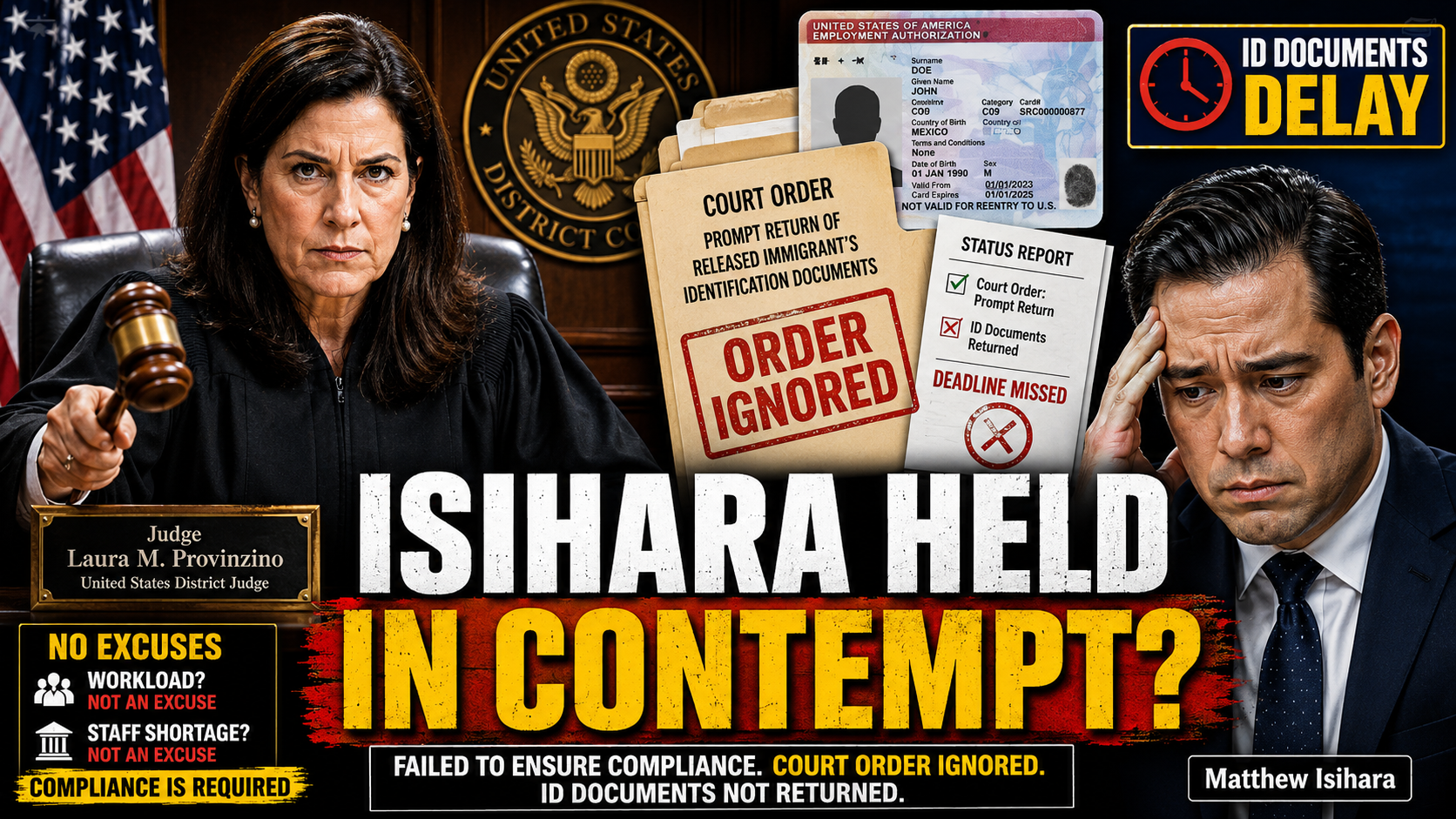
Why Was Matthew Isihara Held in Contempt?
Special Assistant U.S. Attorney Matthew Isihara was held in civil contempt of court by U.S. District Judge Laura M. Provinzino in February 2026 after the court found that he failed to comply with a clear judicial order in an immigration case.
The ruling was not based on the government’s legal arguments or its position on immigration policy. Instead, it focused on the government’s failure to carry out the court’s instructions after an immigrant was ordered released from custody.
Quick Answer
Matthew Isihara was held in civil contempt because Judge Laura Provinzino concluded that he failed to ensure compliance with her order requiring the prompt return of a released immigrant’s identification documents. The judge ruled that heavy workloads and staffing shortages did not excuse the government’s failure to obey the court’s directive.
Who Is Matthew Isihara?
Matthew Isihara is a Special Assistant United States Attorney (SAUSA) who was assigned to assist the U.S. Attorney’s Office for the District of Minnesota during a surge of immigration-related habeas corpus cases. He is also a military attorney serving in the Judge Advocate General’s Corps (JAG).
As government counsel, his role was to represent federal agencies in court and communicate court orders to the appropriate officials responsible for carrying them out.
What Led to the Contempt Order?
The contempt ruling arose from the case of Rigoberto Soto Jimenez, who challenged his immigration detention through a federal habeas corpus petition.
Judge Provinzino ruled that Soto Jimenez should be released and ordered that:
- He be released from ICE custody.
- His property, including identification documents, be returned.
- The government file a status report confirming compliance.
Although Soto Jimenez was eventually released, several problems followed.
According to the court:
- He was released in Texas instead of Minnesota.
- His identification documents were not returned.
- The required status report was not filed by the deadline.
These failures prompted the judge to issue an order requiring the government to explain why it should not be held in contempt.
Why Did the Judge Hold Isihara in Contempt?
After reviewing the evidence and hearing testimony, Judge Provinzino concluded that the requirements for civil contempt had been met.
The court found that:
- The February 9 court order was clear and specific.
- Isihara had notice of the order.
- He did not take the necessary steps to ensure compliance.
- He did not argue that compliance was impossible.
During the hearing, Isihara acknowledged that he had made mistakes.
According to court reports, he apologized to the judge, admitted the case had “slipped through the cracks,” and accepted personal responsibility for failing to move the matter forward.
The Government’s Explanation
Government attorneys argued that the Minnesota U.S. Attorney’s Office was dealing with an unusually large number of immigration detention cases.
Isihara told the court that he had been assigned well over one hundred habeas cases within a short period and that the workload exceeded what one attorney could reasonably manage.
Judge Provinzino acknowledged the workload but concluded that internal staffing problems could not justify ignoring a federal court order.
In a later written order, she stated that the government could not rely on being “too busy” as a defense when individual rights were affected.
What Is Civil Contempt?
Civil contempt is a legal remedy used to encourage compliance with a court order.
Unlike criminal contempt, its primary purpose is not punishment. Instead, it is intended to persuade a party to complete an action the court has already ordered.
Common examples include:
- Returning property.
- Producing required documents.
- Following an injunction.
- Complying with a release order.
Once compliance occurs, civil contempt sanctions often end.
What Penalty Did Matthew Isihara Receive?
Judge Provinzino imposed a conditional civil sanction rather than criminal punishment.
She ordered:
- A $500 daily fine.
- The fine would continue until the government certified that Soto Jimenez had received his identification documents.
The sanction was designed to encourage prompt compliance instead of punishing Isihara for past conduct.
Was the Fine Ever Collected?
No.
The government returned the identification documents shortly after the contempt order.
Because the court’s directive was ultimately satisfied, Judge Provinzino lifted the contempt sanction before any daily fines were actually imposed.
Did the Case End There?
Not entirely.
The Justice Department later appealed the contempt order to the U.S. Court of Appeals for the Eighth Circuit.
The appeal argued, among other things, that personal sanctions should not be imposed on government attorneys for actions carried out by federal agencies. At the time of reporting, the appellate court allowed the appeal to proceed, meaning the legal issues surrounding the contempt ruling remained under review.
Why This Case Matters
The ruling attracted attention because contempt findings against government lawyers are relatively uncommon.
The case also reinforced several important legal principles:
- Court orders must be followed promptly.
- Government attorneys have professional responsibilities to ensure compliance.
- Administrative difficulties do not automatically excuse violations of judicial orders.
- Civil contempt is intended to enforce compliance rather than impose punishment.
The decision became part of a broader discussion about how federal courts respond when government agencies fail to carry out judicial directives during periods of heavy litigation.
Frequently Asked Questions
Who is Matthew Isihara?
Matthew Isihara is a Special Assistant U.S. Attorney who was assigned to assist the U.S. Attorney’s Office for the District of Minnesota during a large number of immigration-related cases. He is also a military attorney.
Why was he held in contempt?
Judge Laura Provinzino found him in civil contempt because the government failed to comply with a court order requiring the prompt return of a released immigrant’s identification documents and other related directives.
Was Matthew Isihara found guilty of a crime?
No. Civil contempt is not a criminal conviction. It is a court mechanism used to compel compliance with judicial orders.
Did Matthew Isihara admit making a mistake?
Yes. During the contempt proceedings, he apologized to the court and acknowledged that the case had “slipped through the cracks” amid an unusually heavy workload.
What happened after the contempt ruling?
The government returned the missing identification documents, the contempt sanction was lifted before fines accrued, and the Justice Department later appealed the ruling.
Final Thoughts
Matthew Isihara was held in civil contempt because the court determined that a clear judicial order had not been followed. Judge Laura Provinzino emphasized that government agencies and their attorneys are expected to comply with court directives regardless of workload or staffing challenges. Although the sanction ended once the required documents were returned, the case remains a notable example of a federal court using civil contempt to enforce compliance with its orders rather than to punish an attorney.
Disclaimer
This article is provided for informational and educational purposes only. It summarizes publicly available court records and reliable news reporting and should not be considered legal advice. Court decisions may be appealed or modified, and readers seeking legal guidance should consult official court records or a qualified attorney.