
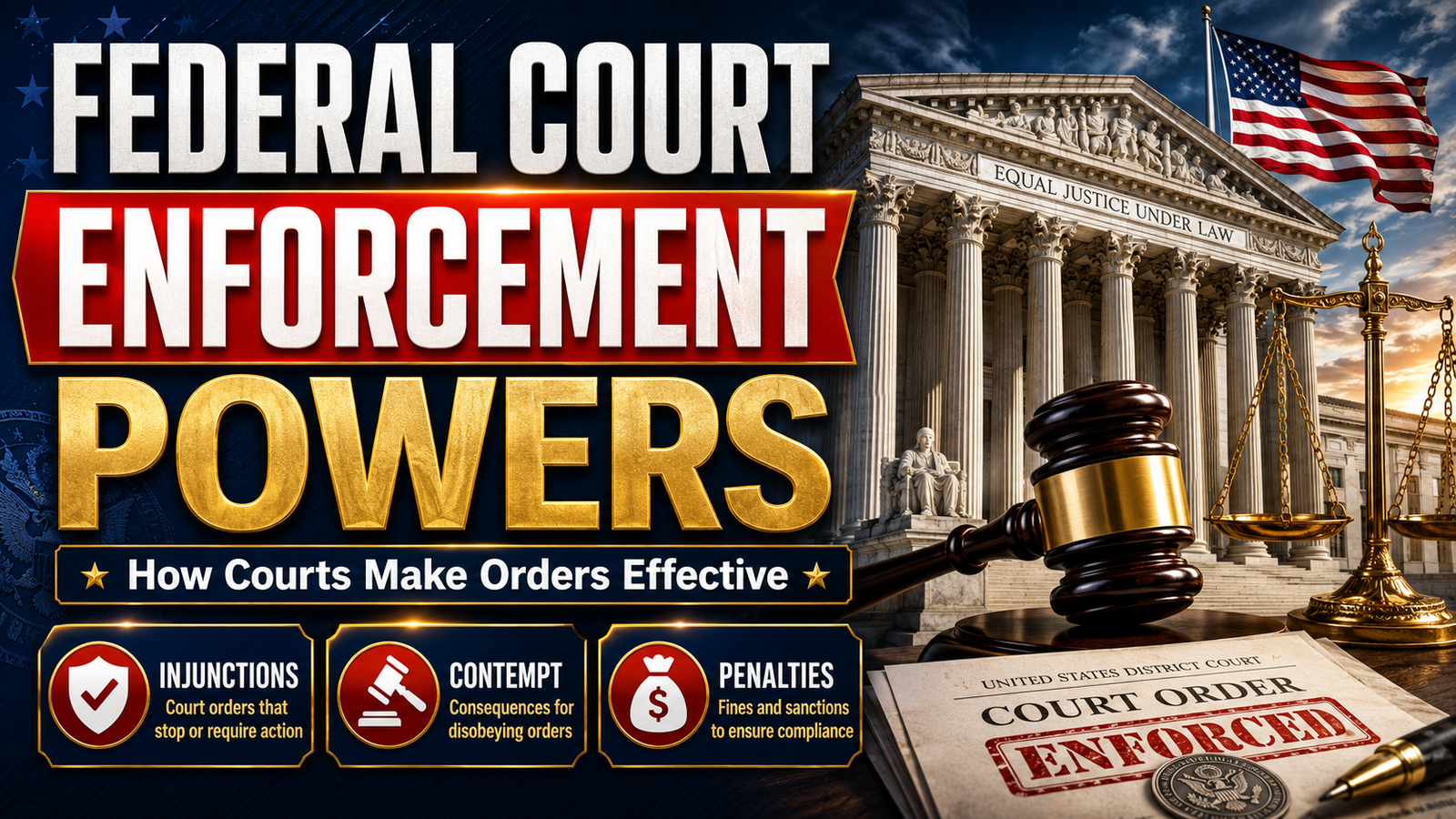
Federal Court Enforcement Powers: How Federal Courts Make Their Orders Effective
Federal courts have the authority to resolve legal disputes, interpret laws, and issue decisions that parties must follow. But a court ruling only has meaning if it can be enforced.
Federal court enforcement powers allow judges to make sure their orders are obeyed, protect the authority of the court, and provide remedies when someone fails to follow a legal decision.
These powers are not unlimited. Federal courts must follow the U.S. Constitution, federal laws, and established legal procedures when enforcing their decisions.
What Are Federal Court Enforcement Powers?
Federal court enforcement powers are the legal tools available to federal judges to ensure compliance with court orders and judgments.
These powers allow courts to:
- Require parties to follow court orders
- Prevent illegal actions
- Compel someone to provide information or evidence
- Penalize violations of court orders
- Protect the rights of individuals involved in a case
The purpose of enforcement is not to give judges unlimited authority. It is designed to make sure court decisions have practical effect.
How Do Federal Courts Enforce Their Orders?
Federal courts use several methods to enforce decisions. The method depends on the type of case, the people involved, and the seriousness of the violation.
Common enforcement tools include:
- Injunctions
- Contempt of court proceedings
- Monetary penalties
- Writs and court orders
- Enforcement through federal agencies
Injunctions: Preventing or Requiring Action
An injunction is a court order that tells a person, organization, or government entity to do something or stop doing something.
Federal judges commonly use injunctions when waiting for a normal legal process could cause serious harm.
Types of Injunctions
Preliminary Injunction
A preliminary injunction temporarily prevents harm while a case is still ongoing.
Example:
A company claims another business is using its confidential information. A federal court may temporarily order the company to stop using that information until the case is resolved.
Permanent Injunction
A permanent injunction is issued after a court reaches a final decision.
Example:
A court may permanently prohibit a company from continuing an illegal practice.
Contempt of Court: Punishing Violations of Court Orders
One of the strongest enforcement tools available to federal courts is contempt of court.
A person or organization may be held in contempt if they intentionally fail to follow a valid court order.
Examples include:
- Ignoring a judge’s order
- Refusing to provide required documents
- Violating an injunction
- Disrupting court proceedings
A contempt finding may result in:
- Fines
- Additional court orders
- Other penalties allowed by law
The court must generally provide notice and an opportunity for the accused party to respond before imposing contempt sanctions.
Civil Contempt vs Criminal Contempt
Federal courts recognize different types of contempt.
| Type | Purpose | Example |
|---|---|---|
| Civil Contempt | Encourage compliance with a court order | Ordering a person to provide missing documents |
| Criminal Contempt | Punish conduct that disrespects court authority | Punishing intentional disruption of court proceedings |
The difference depends on the purpose of the penalty and the circumstances of the violation.
Monetary Penalties and Financial Enforcement
Federal courts can use financial remedies to enforce judgments.
Examples include:
- Ordering payment of damages
- Awarding attorney fees in certain situations
- Imposing fines for violations of court orders
If a person fails to pay a federal court judgment, the winning party may seek enforcement methods such as:
- Property liens
- Asset collection procedures
- Other lawful collection actions
The exact process depends on the type of judgment and applicable federal and state laws.
Writs: Powerful Federal Court Commands
Federal courts can issue different types of writs, which are formal written commands requiring specific action.
Common examples include:
Writ of Habeas Corpus
A habeas corpus petition allows a person in custody to ask a federal court to review whether their detention violates federal law or constitutional rights.
Writ of Mandamus
A writ of mandamus is an extraordinary order requiring a government official or lower court to perform a legal duty.
Federal courts use this remedy only in limited situations because it is considered an exceptional form of relief.
Enforcement Against Government Agencies
Federal courts can review actions taken by government agencies and officials.
If a government action violates federal law or constitutional protections, a court may:
- Block the action
- Require the agency to follow legal requirements
- Order officials to comply with the law
However, courts usually cannot manage everyday government operations. Their role is to determine whether government actions are legally valid.
Federal Court Enforcement in Criminal Cases
Federal courts have enforcement authority in criminal matters involving violations of federal law.
The federal government may use:
- Federal prosecutors
- Law enforcement agencies
- Court-issued warrants
- Criminal judgments
After conviction, federal courts may issue sentences that include:
- Prison terms
- Fines
- Probation
- Supervised release
Federal judges also oversee certain parts of criminal proceedings after sentencing.
What Happens If Someone Ignores a Federal Court Order?
Ignoring a federal court order can lead to serious legal consequences.
Possible outcomes include:
- Contempt proceedings
- Financial penalties
- Additional restrictions
- Enforcement actions
- Criminal consequences in certain situations
However, disagreement with a court ruling does not automatically mean someone is violating the law. A person who believes a decision is wrong usually has the option to appeal.
Can Federal Courts Force Compliance?
Yes, federal courts can require compliance with their lawful orders.
Their authority comes from:
- The U.S. Constitution
- Federal statutes
- The inherent authority of courts to manage cases and enforce judgments
However, federal courts must operate within legal limits. Judges cannot enforce orders that exceed their authority or violate constitutional protections.
Examples of Federal Court Enforcement Powers
Example 1: Environmental Case
A federal court determines that a company violated environmental regulations.
The court may:
- Order the company to stop harmful activity
- Require corrective action
- Impose financial penalties
Example 2: Civil Rights Case
A court finds that a government agency violated constitutional rights.
The court may:
- Issue an injunction
- Require the agency to change its practices
- Monitor compliance in certain cases
Example 3: Business Dispute
A company refuses to provide required documents during a federal lawsuit.
The court may:
- Order production of documents
- Issue sanctions
- Hold the party in contempt if appropriate
Limits on Federal Court Enforcement Powers
Federal judges have significant authority, but their power has boundaries.
Courts cannot:
- Create new laws
- Ignore constitutional protections
- Act outside their legal jurisdiction
- Punish people without following required procedures
Appeals courts also review whether lower courts used enforcement powers properly.
Why Federal Court Enforcement Powers Matter
Court decisions are only effective when people and organizations follow them. Enforcement powers allow federal courts to protect legal rights, resolve disputes, and maintain respect for the judicial system.
Without enforcement authority, court rulings could be ignored, making the justice system ineffective.
Frequently Asked Questions
What happens if someone violates a federal court order?
A federal court may respond through contempt proceedings, fines, additional orders, or other legal remedies.
Can a federal judge put someone in jail for contempt?
In certain situations, yes. Criminal contempt may result in jail time if permitted under applicable law and proper procedures are followed.
Can federal courts enforce decisions against the government?
Yes. Federal courts can order government agencies and officials to comply with federal law and constitutional requirements.
Are federal court orders automatically permanent?
Not always. Some orders are temporary, such as preliminary injunctions. Others become permanent after a final judgment.
Can someone challenge a federal court enforcement order?
Yes. Parties may have options to request review, modify an order, or appeal depending on the circumstances.
Conclusion
Federal court enforcement powers allow judges to make their decisions effective and ensure compliance with the law. Through tools such as injunctions, contempt proceedings, writs, and financial remedies, federal courts can protect legal rights and uphold their authority.
At the same time, these powers are limited by constitutional protections and legal procedures. The goal of enforcement is not unlimited judicial control but ensuring that lawful court decisions are respected and followed.’
Disclaimer:
The information in this article is provided for general educational and informational purposes only and should not be considered legal advice. Federal court procedures, laws, and enforcement powers can vary depending on the facts of each case and may change over time. While we aim to provide accurate and reliable information, we do not guarantee that every detail applies to every situation. Readers should consult a qualified attorney or legal professional for advice regarding specific legal matters. This website does not create an attorney-client relationship or provide legal representation.